
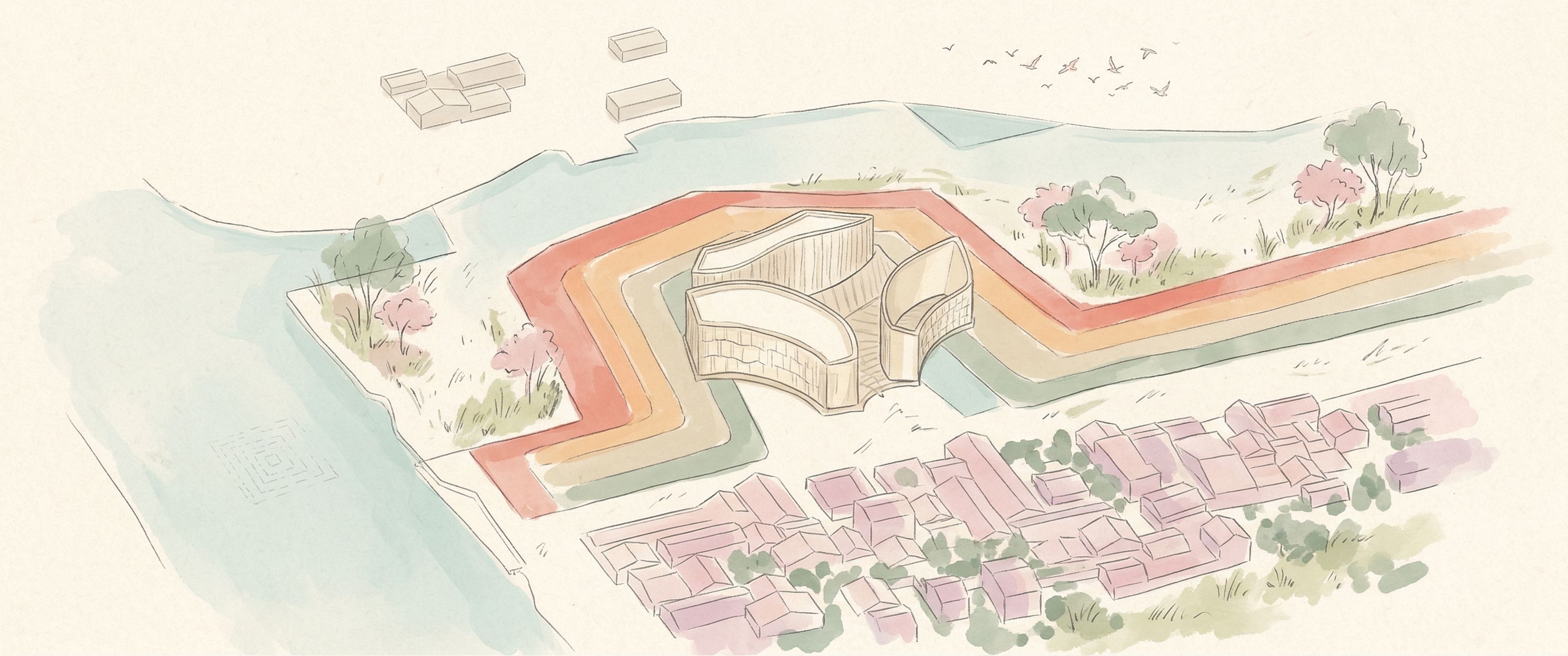
Transform this Rhino massing/site model into a soft hand-drawn architectural landscape illustration inspired by a vintage storybook / mid-century nature print aesthetic. Keep the exact geometry, camera angle, site layout, building placement, topography, and circulation lines from the original model, but reinterpret everything as a loose, expressive drawing rather than a 3D rendering. Style the image like a delicate ink-and-pastel drawing with: soft watercolor washes muted pastel greens, blush pinks, pale beige, dusty sage, faded coral, and warm cream tones thin, sketchy linework with slight irregularity minimal shading a flat, atmospheric composition subtle paper texture gentle layered vegetation drawn in an impressionistic way light, whimsical landscape details The building forms should read clearly but be simplified into an illustrated architectural composition, with curved walls and masses expressed through soft outlines and light tonal fills instead of realistic materials. Avoid photorealism entirely. The site edges, pathways, water, and land bands should become graphic, painterly layers with softened boundaries and harmonious colors. The surrounding context should feel like an illustrated ecological setting: abstracted trees and planting soft grassy textures light expressive marks for landscape movement possible birds or subtle animated natural elements in the sky for atmosphere simplified water with pale blue-green tonal washes Overall mood: calm, poetic, airy, nostalgic, ecological, hand-crafted, architectural but artistic. Important constraints: Do not change the geometry Do not redesign the building Do not alter the site organization Do not make it photorealistic Do not add modern rendering effects Do not use hard shadows, glossy materials, or realistic textures Preserve the Rhino view exactly, only restyle it as a soft illustrated drawing, keep exact camera angle
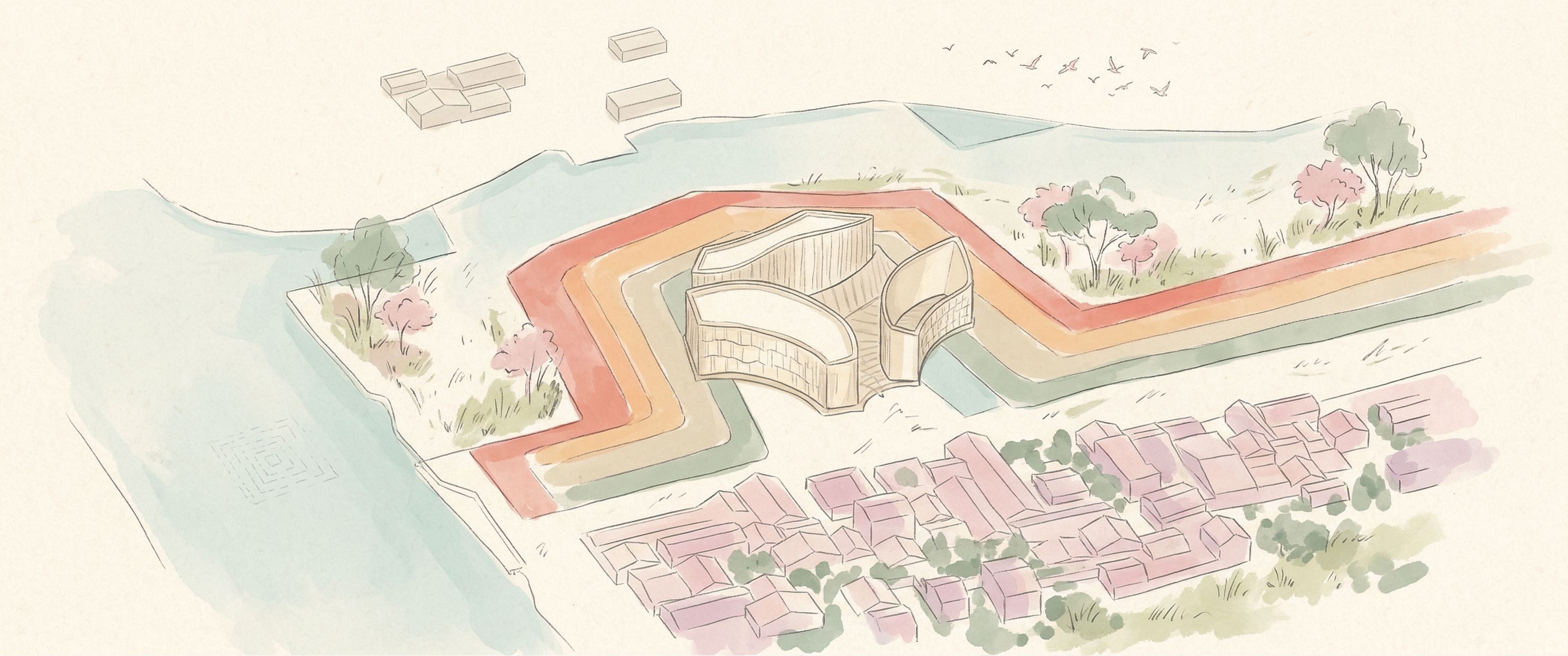
PromptTransform this Rhino massing/site model into a soft hand-drawn architectural landscape illustration inspired by a vintage storybook / mid-century nature print aesthetic. Keep the exact geometry, camera angle, site layout, building placement, topography, and circulation lines from the original model, but reinterpret everything as a loose, expressive drawing rather than a 3D rendering. Style the image like a delicate ink-and-pastel drawing with: soft watercolor washes muted pastel greens, blush pinks, pale beige, dusty sage, faded coral, and warm cream tones thin, sketchy linework with slight irregularity minimal shading a flat, atmospheric composition subtle paper texture gentle layered vegetation drawn in an impressionistic way light, whimsical landscape details The building forms should read clearly but be simplified into an illustrated architectural composition, with curved walls and masses expressed through soft outlines and light tonal fills instead of realistic materials. Avoid photorealism entirely. The site edges, pathways, water, and land bands should become graphic, painterly layers with softened boundaries and harmonious colors. The surrounding context should feel like an illustrated ecological setting: abstracted trees and planting soft grassy textures light expressive marks for landscape movement possible birds or subtle animated natural elements in the sky for atmosphere simplified water with pale blue-green tonal washes Overall mood: calm, poetic, airy, nostalgic, ecological, hand-crafted, architectural but artistic. Important constraints: Do not change the geometry Do not redesign the building Do not alter the site organization Do not make it photorealistic Do not add modern rendering effects Do not use hard shadows, glossy materials, or realistic textures Preserve the Rhino view exactly, only restyle it as a soft illustrated drawing, keep exact camera angle
Date16 April 2026
Share