
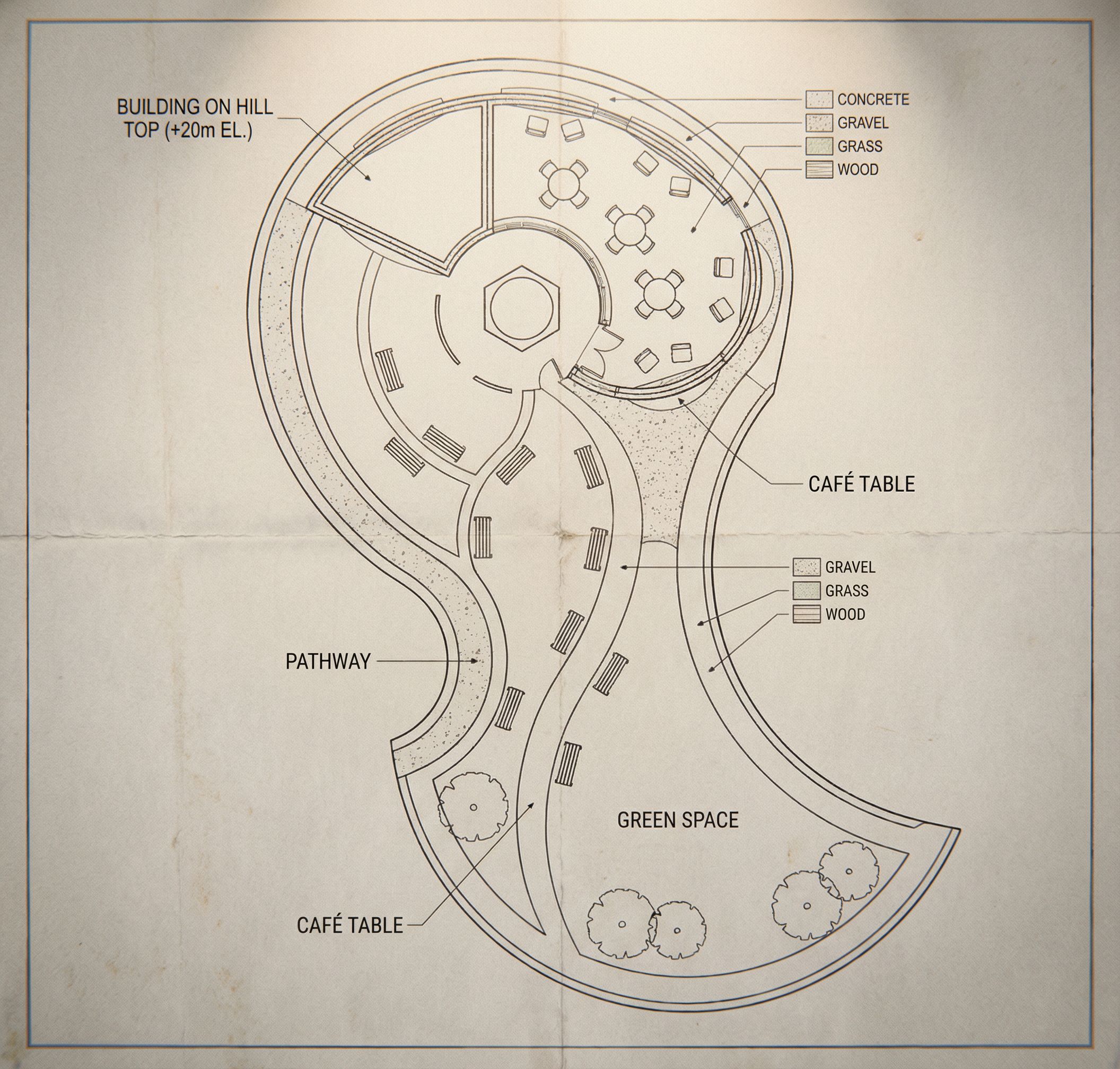
Enhance the existing site without changing or redesigning the current site plan, layout, geometry, or design logic. All existing boundaries, paths, circulation lines, levels, and spatial relationships must remain exactly as they are. The site has a gradual and continuous slope that gently rises toward an elevation of +20 meters. This slope must be fully respected and preserved, with no regrading or modification of the existing topography. Fill all unused and empty areas with green grass and simple landscape surfaces that follow the existing slope naturally. Maintain the current path alignments and geometry; improve their usability only through surface definition and detailing, transforming them into pedestrian walkways without altering their direction or shape. Introduce stair steps only where the natural slope requires it, carefully integrated into the existing paths and following the gradual elevation change, without flattening or cutting the terrain. Add benches along the walkways at logical resting points, especially where elevation changes occur, aligned with the existing circulation system. Surround the site with asphalt roads and nearby urban buildings strictly as contextual elements, reinforcing the site’s urban setting without affecting the internal site layout. Within the site, place café seating areas with tables and chairs, kiosks, stalls, and cultural booths inside the existing open spaces, ensuring all elements adapt to the sloped terrain. All new elements must be created as Revit-compatible components Floors, Model Lines, Site Components, or Families, properly categorized and leveled, and suitable for direct use in Autodesk Revit. while fully preserving the original site plan and smoothly responding to the gradual slope up to +20 meters THIS IS THE MOST IMPORTANT THING THE BUILDING SHOULD BE +20 M HIGHER THEN STREET. BUILDING SHOULD BE ON TOP OF THE HILLS
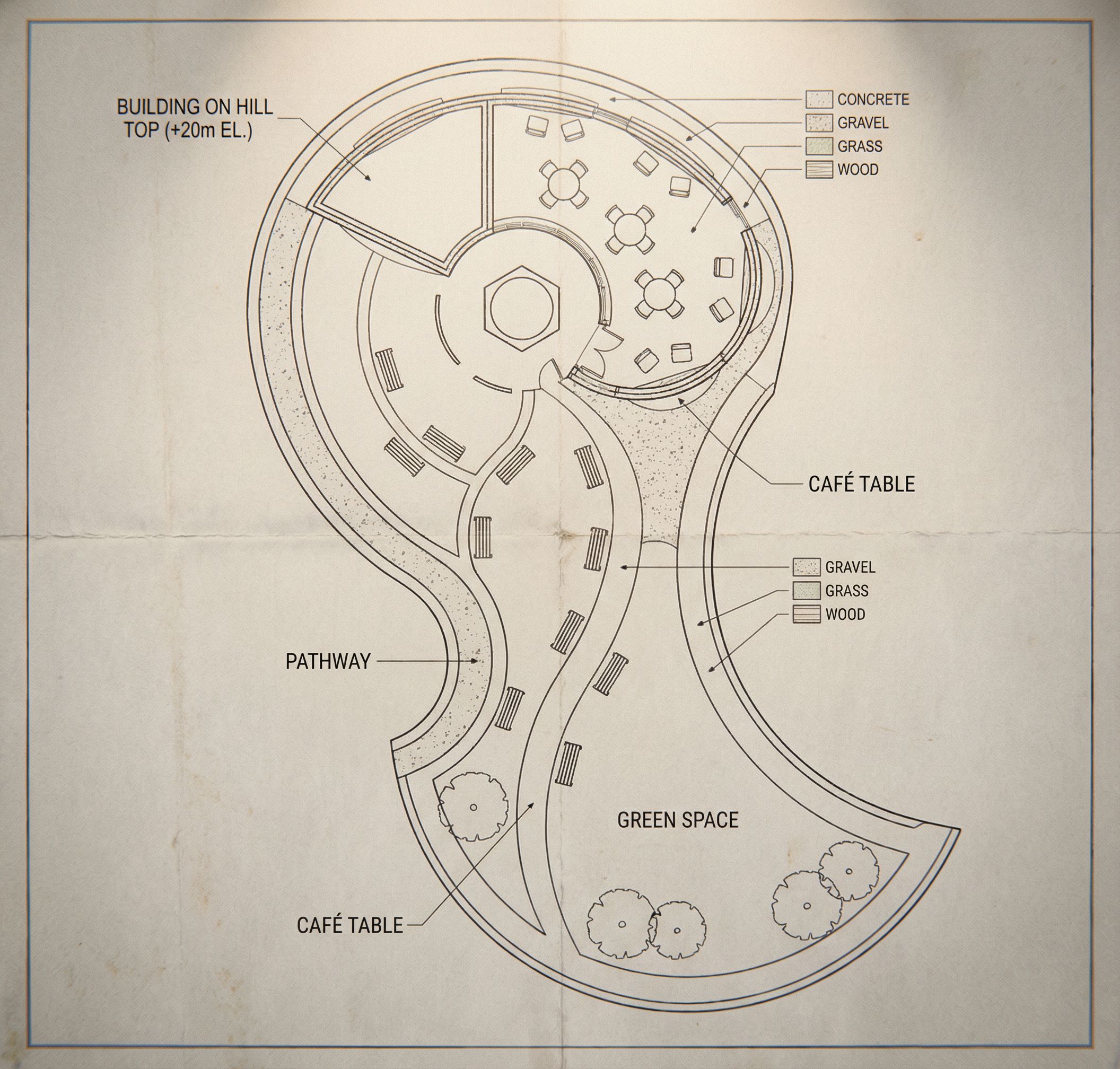
PromptEnhance the existing site without changing or redesigning the current site plan, layout, geometry, or design logic. All existing boundaries, paths, circulation lines, levels, and spatial relationships must remain exactly as they are. The site has a gradual and continuous slope that gently rises toward an elevation of +20 meters. This slope must be fully respected and preserved, with no regrading or modification of the existing topography. Fill all unused and empty areas with green grass and simple landscape surfaces that follow the existing slope naturally. Maintain the current path alignments and geometry; improve their usability only through surface definition and detailing, transforming them into pedestrian walkways without altering their direction or shape. Introduce stair steps only where the natural slope requires it, carefully integrated into the existing paths and following the gradual elevation change, without flattening or cutting the terrain. Add benches along the walkways at logical resting points, especially where elevation changes occur, aligned with the existing circulation system. Surround the site with asphalt roads and nearby urban buildings strictly as contextual elements, reinforcing the site’s urban setting without affecting the internal site layout. Within the site, place café seating areas with tables and chairs, kiosks, stalls, and cultural booths inside the existing open spaces, ensuring all elements adapt to the sloped terrain. All new elements must be created as Revit-compatible components (Floors, Model Lines, Site Components, or Families), properly categorized and leveled, and suitable for direct use in Autodesk Revit. while fully preserving the original site plan and smoothly responding to the gradual slope up to +20 meters THIS IS THE MOST IMPORTANT THING THE BUILDING SHOULD BE +20 M HIGHER THEN STREET. BUILDING SHOULD BE ON TOP OF THE HILLS
Date05 February 2026
Share