
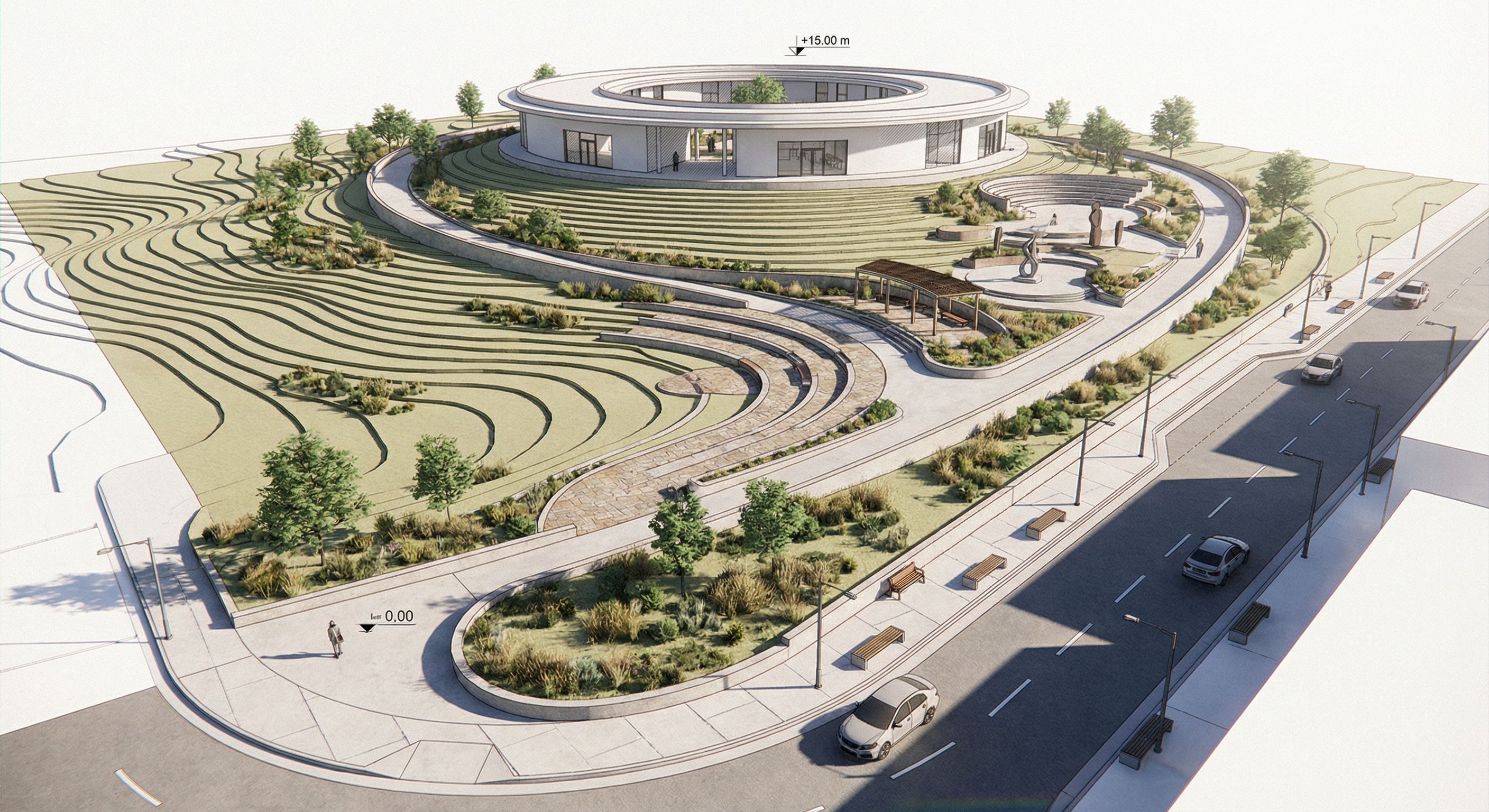
Place this architectural plan and circulation paths on a site with a variable, central-axis topography. The building is positioned at the highest elevation of the site and acts as the central focal point of the project. The main circulation path begins at elevation 0.00. As the path moves toward the building and approaches the project’s center, the ground level increases gradually in one-meter increments, rising step by step until it reaches the maximum elevation at the building location up to +15.00 meters. The terrain should be dynamic and undulating, with subtle rises and falls along the path, while maintaining an overall upward progression toward the building. The circulation path must be fully integrated with the sloped terrain, formed through gentle ramps, soft terracing, and gradual platforms, avoiding abrupt level changes. Along the edge of the main path, design an urban street that provides vehicular access and reinforces the project’s urban character. Pedestrian and vehicular connections should be clear, safe, and legible. In the architectural plan, doors and windows should be clearly defined to enhance interior–exterior visual relationships. Cultural, artistic, and recreational spaces should be distributed along the path and across different elevation levels, including open and semi-open gathering areas for social and cultural activities. Buildings and landscape elements should appear naturally embedded into the slope, minimizing heavy excavation. The final output should be clean, architectural, and suitable for a final university presentation and professional sheet layout.

PromptPlace this architectural plan and circulation paths on a site with a variable, central-axis topography. The building is positioned at the highest elevation of the site and acts as the central focal point of the project. The main circulation path begins at elevation 0.00. As the path moves toward the building and approaches the project’s center, the ground level increases gradually in one-meter increments, rising step by step until it reaches the maximum elevation at the building location (up to +15.00 meters). The terrain should be dynamic and undulating, with subtle rises and falls along the path, while maintaining an overall upward progression toward the building. The circulation path must be fully integrated with the sloped terrain, formed through gentle ramps, soft terracing, and gradual platforms, avoiding abrupt level changes. Along the edge of the main path, design an urban street that provides vehicular access and reinforces the project’s urban character. Pedestrian and vehicular connections should be clear, safe, and legible. In the architectural plan, doors and windows should be clearly defined to enhance interior–exterior visual relationships. Cultural, artistic, and recreational spaces should be distributed along the path and across different elevation levels, including open and semi-open gathering areas for social and cultural activities. Buildings and landscape elements should appear naturally embedded into the slope, minimizing heavy excavation. The final output should be clean, architectural, and suitable for a final university presentation and professional sheet layout.
Date04 February 2026
Share