
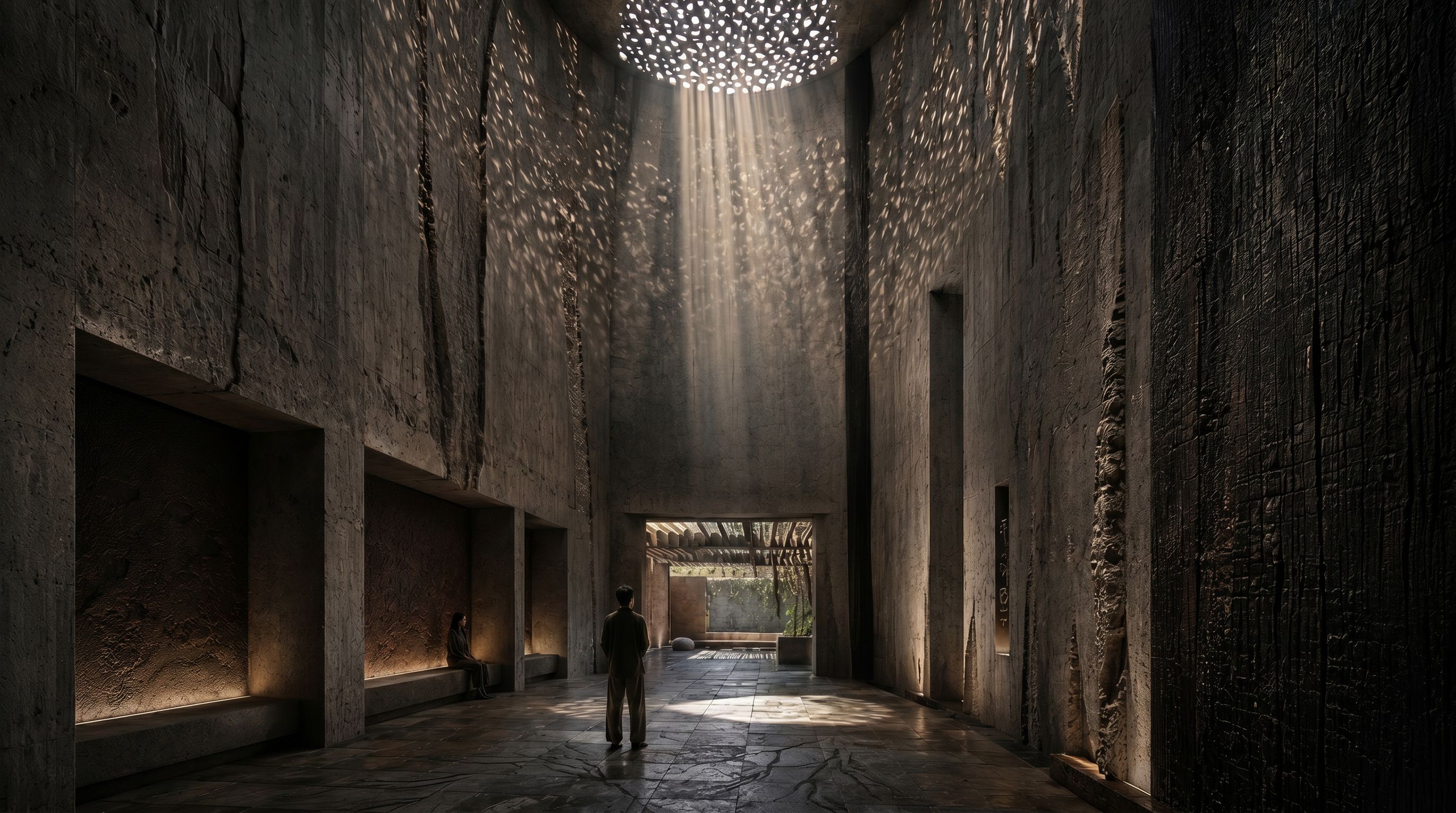
Create an ultra-detailed, atmospheric interior architectural visualization of a “Tree / Shadow Memory Experience Room” for a rural visitor center and ecomuseum in Hıdırbey, Samandağ, on the slopes of Musa Mountain. This is not a generic tree-themed room, not a decorative nature exhibition, and not a literal forest interior. It is a ritual architectural space about tree, shade, coolness, spiritual slowness, rootedness, and collective memory, inspired by the legendary and cultural presence of Musa Ağacı in Hıdırbey. The space should feel as if Peter Zumthor and Tadao Ando reinterpreted the memory of Musa Ağacı and the human need for shade in a hot rural landscape. From Tadao Ando, bring: silence, geometric clarity, controlled darkness, minimalism, thick walls, emotional emptiness, and precise cuts of natural light. From Peter Zumthor, bring: tactile materiality, smell, atmosphere, coolness, acoustic softness, ritual presence, emotional weight, and the idea of absence becoming space, like in Bruder Klaus Field Chapel — but do not copy it literally. Instead of reproducing that chapel, reinterpret its logic for Hıdırbey: the tree should be present through its traces, shadow, coolness, verticality, and memory, not through direct literal representation. This space should tell a story: The visitor comes from the bright, hot, open rural exterior or from a digital exhibition sequence. Outside there is sun, heat, light, movement, village life, and dryness. Then the visitor enters a narrow, dim, compressed threshold, leaving brightness behind. The temperature seems to drop. Sound becomes softer. The ceiling lowers. The walls become thicker. The body slows down. This threshold should feel like entering the shaded depth beneath a tree canopy, or like moving into the hidden interior of a trunk, root system, or sacred grove. It should feel like a transition from exposed landscape to protective shadow. After this compressed entry, the space opens into a tall, vertical, introverted main chamber. This chamber is the heart of the Tree Experience Room. It should feel like a shadow sanctuary, a place where the visitor senses the presence of tree through architecture. The room should evoke the tree as: a giver of shade a producer of coolness a ritual focus a gathering point a mediator between earth and sky a living actor connecting soil, root, water, air, shadow, and people The architecture should not imitate a literal tree shape in a naive way. No cartoon-like branches, no decorative leaf motifs everywhere, no obvious themed-design clichés. Instead, the architecture should express the memory and trace of tree. The tree is present in the space as: verticality filtered light shadow movement root-like marks trunk-like negative imprints coolness scent silence an upward pull toward light a protective interior darkness The main chamber should be monolithic and calm, but internally charged with material and spiritual intensity. The walls should feel thick, sheltering, ancient, tactile, and deeply architectural. Use a layered material palette connected to Hıdırbey’s rural context: local stone base surfaces rammed earth or earth-toned plaster in selected wall zones thick lime plaster exposed concrete used carefully as a monolithic, quiet structural body charred timber or darkened timber surfaces in specific places concrete or plaster surfaces bearing the negative imprint of tree trunks or timber formwork subtle marks like the memory of bark, grain, or burnt wood occasional rough handmade imperfections cool mineral surfaces tactile transitions between stone, earth, concrete, timber, and shadow The strongest spatial idea should be this: the room feels as if trees once occupied the interior volume, and what remains is their memory in the walls, the darkness, and the shaft of light. Use the logic of absence. The tree should not stand there as an object; its trace should define the space. The walls may contain: vertical negative cavities or trunk-like impressions subtle charred black textures recalling burnt wood memory textured concrete bearing rough timber formwork marks deep wall scars like the imprint of removed trunks root-like channels or incisions emerging near the floor and rising upward traces of bark texture embedded in plaster or concrete carved dark recesses suggesting the memory of a grove The floor should be cool, tactile, and grounded, made of local natural stone or rough matte stone slabs, possibly slightly uneven, never polished, never glossy. The floor should feel cool underfoot, shaded, and acoustically soft. It should reinforce slowness and bodily awareness. It may contain: subtle darker zones like the memory of moisture faint root-like patterns a central area of quiet emptiness occasional soft reflected light a minimal, tactile surface that absorbs brightness rather than reflecting it The ceiling must be one of the most important architectural elements. It should suggest the canopy of a tree without literally becoming one. The ceiling may be heavy and dark in some parts, but open and filtered in others. Use: a tall vertical volume a narrowing or opening upward movement one major skylight or several carefully controlled narrow skylight incisions filtered top light entering through a perforated or layered canopy-like structure subtle branching geometry in the upper light filtering system delicate patterns of light and shadow falling onto walls and floor like moving shade beneath a tree a sense that daylight passes through invisible leaves above The light must be extremely controlled and poetic. No bright even illumination, no commercial spotlights, no generic museum lighting. The room should remain mostly dim, cool, shaded, and introspective. Light should enter from above in a spiritual but non-religious way. Use: thin vertical shafts of light soft filtered natural light from a roof opening warm but very subtle concealed lighting in benches or low niches low indirect light touching rough wall textures shadow moving slowly across the floor and walls visible dust particles in the light beams deep contrast between illuminated fragments and dark recesses a cool ambient tone balanced by warm subtle highlights The atmosphere should strongly communicate shade as an ecological and social necessity in Hıdırbey. This is not just aesthetic darkness. This is the architecture of protection from heat. The space should make the visitor feel: relief from sun coolness after brightness physical comfort in shadow emotional calm ritual pause a desire to sit, look upward, breathe slowly, and remain silent The chamber should have a strong vertical spiritual character. The visitor should feel gently pulled upward, as if following the invisible growth of a tree from root to canopy. This upward movement can be suggested through: tall proportions a shaft of light above narrowing geometry vertical wall textures rising traces in the surfaces a central void subtle orientation of the eye toward the top opening The room should include a central contemplative zone, mostly empty, where the visitor stands in silence. Do not clutter the center with furniture or objects. The emptiness should feel charged and meaningful. This central void can work like an inner shaded clearing. Along the edges, include carefully integrated architectural elements: deeply recessed sitting niches in thick walls low stone or plaster benches where visitors can quietly sit one or two wall recesses containing subtle material traces: dried leaf shadows, seed memory, bark-like textures, root marks a few tactile wall zones encouraging touch one darker wall where the negative impression of tree trunks is strongest a threshold recess marking the entry another recess hinting at the transition toward the next space possibly one semi-circular or elongated seating ledge where a person may pause in the shade The digital component must remain extremely subtle and integrated. This is a digital experience room, but technology must never dominate visually. No big screens, no LED walls, no flashy immersive tech. Instead, use almost invisible, embedded media: slow projection of shifting leaf-shadow patterns very faint animated root traces running across lower walls subtle moving shadow textures on concrete or earth plaster almost imperceptible abstract projections suggesting air moving through leaves delicate shadow-memory of branches very slow ambient motion, as if the room itself is breathing shade minimal audiovisual atmosphere, hidden within architecture The sound environment should be implied through the image and atmosphere: muffled silence slight breeze distant water presence, as if the stream is not far away rustling leaves remembered rather than literally heard low quiet resonance acoustic softness due to thick walls and textured surfaces a sense of calm collective pause The sensory atmosphere should evoke: cool stone mineral dust slightly humid air in shade faint smell of lime plaster and earth hint of charred wood the protective coolness of tree shadow in a hot Mediterranean rural climate the bodily memory of sitting under a large tree in summer The space must also contain the philosophical presence of Musa Ağacı. Do not illustrate the legend directly with symbolic figures or narrative murals. Instead, transform the spiritual and ritual layer into architecture. Translate the legend into spatial qualities: rootedness emergence from earth relation between water and growth sacred pause gathering under shade silence upward light a place of intention and reflection tree as living witness tree as link between earth and sky tree as an actor around which people gather The room should feel sacred without becoming a religious chapel. It is important that it remains part of an ecomuseum / rural visitor center, not a place of worship. So the mood should be: contemplative calm ritualistic reverent toward nature and memory quiet intimate atmospheric communal in potential, solitary in experience At the end of the chamber, the visitor should not abruptly exit into open brightness. Instead, the space should lead into a semi-open shaded courtyard or cooling threshold space. This transition is extremely important. It completes the tree story. Inside, the visitor experiences the memory of tree. Then outside, they experience actual shade, air, and rest. This semi-open courtyard should include: filtered shade through a wooden pergola or perforated canopy shadow patterns cast on the ground a cool microclimate low stone seating edges perhaps a subtle connection to breeze or the sound of water a sense of refuge a place where people can pause, gather lightly, and sit in shade strong continuity between the inner chamber and the outdoor shaded life of Hıdırbey The courtyard should feel like the architectural continuation of the room’s inner message: tree as shade, tree as gathering, tree as relief, tree as everyday ritual. If people are shown, include only one or two quiet visitors. They should be still, contemplative, not posing, not smiling at camera, not touristic. They may: sit quietly in a wall niche stand in the central chamber looking upward touch a textured wall move slowly toward the shaded courtyard They are only there for scale and atmosphere. The visual composition should be a refined high-end architectural visualization, almost like a poetic architectural photograph. Use: eye-level or slightly low eye-level perspective a view that captures the compressed threshold opening into the tall chamber a sense of progression from darkness to filtered light visible wall thickness strong material tactility subtle shadow depth careful framing of the skylight or canopy opening a hint of the semi-open shaded courtyard beyond no visual clutter no unnecessary objects no decorative furniture overload Color palette must be restrained and deeply atmospheric: stone gray warm earth beige muted clay soft lime tones dark charcoal charred brown-black dusty mineral gray filtered amber light cool shadow tones subtle greenish-gray reflected tones only if extremely minimal Avoid bright colors, glossy finishes, shiny metals, or artificial-looking materials. Everything should feel timeless, grounded, cool, tactile, and real. The final image should communicate: the memory of a tree without showing a literal tree the relief of entering shade from heat the ritual of pausing beneath a protective canopy the spiritual atmosphere of Musa Ağacı translated into architectural space the relationship between root, trunk, shadow, and sky the fusion of Ando’s silent geometry and Zumthor’s tactile atmosphere a deeply local, philosophical, and sensory experience rooted in Hıdırbey The final atmosphere should make the viewer feel: “I have entered the inner memory of shade.” “This space is cool, quiet, rooted, and protective.” “The tree is absent as an object, but fully present as atmosphere, trace, and ritual.” “This is not a themed room; this is an architectural experience of shadow, memory, and rootedness.” Ultra-detailed, highly tactile, emotionally powerful, sacred but not religious, cool shaded atmosphere, vertical contemplative chamber, negative tree imprints, charred timber memory, monolithic architecture, filtered top light, moving shadow patterns, semi-open shaded courtyard, Hıdırbey rural context, Musa Ağacı memory, Peter Zumthor atmosphere, Tadao Ando light discipline, architectural masterpiece, cinematic but restrained, ultra realistic, 16:9.
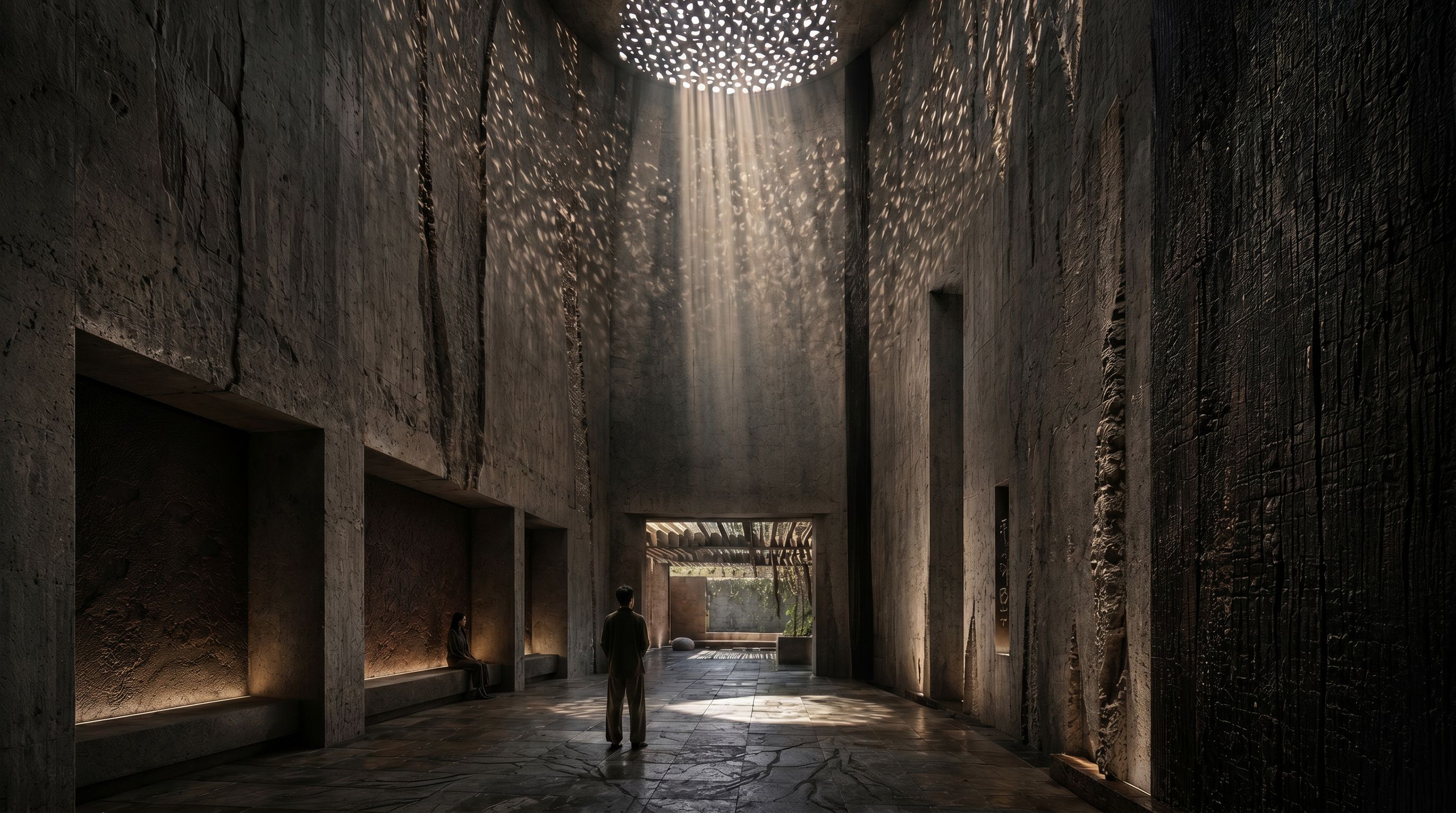
PromptCreate an ultra-detailed, atmospheric interior architectural visualization of a “Tree / Shadow Memory Experience Room” for a rural visitor center and ecomuseum in Hıdırbey, Samandağ, on the slopes of Musa Mountain. This is not a generic tree-themed room, not a decorative nature exhibition, and not a literal forest interior. It is a ritual architectural space about tree, shade, coolness, spiritual slowness, rootedness, and collective memory, inspired by the legendary and cultural presence of Musa Ağacı in Hıdırbey. The space should feel as if Peter Zumthor and Tadao Ando reinterpreted the memory of Musa Ağacı and the human need for shade in a hot rural landscape. From Tadao Ando, bring: silence, geometric clarity, controlled darkness, minimalism, thick walls, emotional emptiness, and precise cuts of natural light. From Peter Zumthor, bring: tactile materiality, smell, atmosphere, coolness, acoustic softness, ritual presence, emotional weight, and the idea of absence becoming space, like in Bruder Klaus Field Chapel — but do not copy it literally. Instead of reproducing that chapel, reinterpret its logic for Hıdırbey: the tree should be present through its traces, shadow, coolness, verticality, and memory, not through direct literal representation. This space should tell a story: The visitor comes from the bright, hot, open rural exterior or from a digital exhibition sequence. Outside there is sun, heat, light, movement, village life, and dryness. Then the visitor enters a narrow, dim, compressed threshold, leaving brightness behind. The temperature seems to drop. Sound becomes softer. The ceiling lowers. The walls become thicker. The body slows down. This threshold should feel like entering the shaded depth beneath a tree canopy, or like moving into the hidden interior of a trunk, root system, or sacred grove. It should feel like a transition from exposed landscape to protective shadow. After this compressed entry, the space opens into a tall, vertical, introverted main chamber. This chamber is the heart of the Tree Experience Room. It should feel like a shadow sanctuary, a place where the visitor senses the presence of tree through architecture. The room should evoke the tree as: a giver of shade a producer of coolness a ritual focus a gathering point a mediator between earth and sky a living actor connecting soil, root, water, air, shadow, and people The architecture should not imitate a literal tree shape in a naive way. No cartoon-like branches, no decorative leaf motifs everywhere, no obvious themed-design clichés. Instead, the architecture should express the memory and trace of tree. The tree is present in the space as: verticality filtered light shadow movement root-like marks trunk-like negative imprints coolness scent silence an upward pull toward light a protective interior darkness The main chamber should be monolithic and calm, but internally charged with material and spiritual intensity. The walls should feel thick, sheltering, ancient, tactile, and deeply architectural. Use a layered material palette connected to Hıdırbey’s rural context: local stone base surfaces rammed earth or earth-toned plaster in selected wall zones thick lime plaster exposed concrete used carefully as a monolithic, quiet structural body charred timber or darkened timber surfaces in specific places concrete or plaster surfaces bearing the negative imprint of tree trunks or timber formwork subtle marks like the memory of bark, grain, or burnt wood occasional rough handmade imperfections cool mineral surfaces tactile transitions between stone, earth, concrete, timber, and shadow The strongest spatial idea should be this: the room feels as if trees once occupied the interior volume, and what remains is their memory in the walls, the darkness, and the shaft of light. Use the logic of absence. The tree should not stand there as an object; its trace should define the space. The walls may contain: vertical negative cavities or trunk-like impressions subtle charred black textures recalling burnt wood memory textured concrete bearing rough timber formwork marks deep wall scars like the imprint of removed trunks root-like channels or incisions emerging near the floor and rising upward traces of bark texture embedded in plaster or concrete carved dark recesses suggesting the memory of a grove The floor should be cool, tactile, and grounded, made of local natural stone or rough matte stone slabs, possibly slightly uneven, never polished, never glossy. The floor should feel cool underfoot, shaded, and acoustically soft. It should reinforce slowness and bodily awareness. It may contain: subtle darker zones like the memory of moisture faint root-like patterns a central area of quiet emptiness occasional soft reflected light a minimal, tactile surface that absorbs brightness rather than reflecting it The ceiling must be one of the most important architectural elements. It should suggest the canopy of a tree without literally becoming one. The ceiling may be heavy and dark in some parts, but open and filtered in others. Use: a tall vertical volume a narrowing or opening upward movement one major skylight or several carefully controlled narrow skylight incisions filtered top light entering through a perforated or layered canopy-like structure subtle branching geometry in the upper light filtering system delicate patterns of light and shadow falling onto walls and floor like moving shade beneath a tree a sense that daylight passes through invisible leaves above The light must be extremely controlled and poetic. No bright even illumination, no commercial spotlights, no generic museum lighting. The room should remain mostly dim, cool, shaded, and introspective. Light should enter from above in a spiritual but non-religious way. Use: thin vertical shafts of light soft filtered natural light from a roof opening warm but very subtle concealed lighting in benches or low niches low indirect light touching rough wall textures shadow moving slowly across the floor and walls visible dust particles in the light beams deep contrast between illuminated fragments and dark recesses a cool ambient tone balanced by warm subtle highlights The atmosphere should strongly communicate shade as an ecological and social necessity in Hıdırbey. This is not just aesthetic darkness. This is the architecture of protection from heat. The space should make the visitor feel: relief from sun coolness after brightness physical comfort in shadow emotional calm ritual pause a desire to sit, look upward, breathe slowly, and remain silent The chamber should have a strong vertical spiritual character. The visitor should feel gently pulled upward, as if following the invisible growth of a tree from root to canopy. This upward movement can be suggested through: tall proportions a shaft of light above narrowing geometry vertical wall textures rising traces in the surfaces a central void subtle orientation of the eye toward the top opening The room should include a central contemplative zone, mostly empty, where the visitor stands in silence. Do not clutter the center with furniture or objects. The emptiness should feel charged and meaningful. This central void can work like an inner shaded clearing. Along the edges, include carefully integrated architectural elements: deeply recessed sitting niches in thick walls low stone or plaster benches where visitors can quietly sit one or two wall recesses containing subtle material traces: dried leaf shadows, seed memory, bark-like textures, root marks a few tactile wall zones encouraging touch one darker wall where the negative impression of tree trunks is strongest a threshold recess marking the entry another recess hinting at the transition toward the next space possibly one semi-circular or elongated seating ledge where a person may pause in the shade The digital component must remain extremely subtle and integrated. This is a digital experience room, but technology must never dominate visually. No big screens, no LED walls, no flashy immersive tech. Instead, use almost invisible, embedded media: slow projection of shifting leaf-shadow patterns very faint animated root traces running across lower walls subtle moving shadow textures on concrete or earth plaster almost imperceptible abstract projections suggesting air moving through leaves delicate shadow-memory of branches very slow ambient motion, as if the room itself is breathing shade minimal audiovisual atmosphere, hidden within architecture The sound environment should be implied through the image and atmosphere: muffled silence slight breeze distant water presence, as if the stream is not far away rustling leaves remembered rather than literally heard low quiet resonance acoustic softness due to thick walls and textured surfaces a sense of calm collective pause The sensory atmosphere should evoke: cool stone mineral dust slightly humid air in shade faint smell of lime plaster and earth hint of charred wood the protective coolness of tree shadow in a hot Mediterranean rural climate the bodily memory of sitting under a large tree in summer The space must also contain the philosophical presence of Musa Ağacı. Do not illustrate the legend directly with symbolic figures or narrative murals. Instead, transform the spiritual and ritual layer into architecture. Translate the legend into spatial qualities: rootedness emergence from earth relation between water and growth sacred pause gathering under shade silence upward light a place of intention and reflection tree as living witness tree as link between earth and sky tree as an actor around which people gather The room should feel sacred without becoming a religious chapel. It is important that it remains part of an ecomuseum / rural visitor center, not a place of worship. So the mood should be: contemplative calm ritualistic reverent toward nature and memory quiet intimate atmospheric communal in potential, solitary in experience At the end of the chamber, the visitor should not abruptly exit into open brightness. Instead, the space should lead into a semi-open shaded courtyard or cooling threshold space. This transition is extremely important. It completes the tree story. Inside, the visitor experiences the memory of tree. Then outside, they experience actual shade, air, and rest. This semi-open courtyard should include: filtered shade through a wooden pergola or perforated canopy shadow patterns cast on the ground a cool microclimate low stone seating edges perhaps a subtle connection to breeze or the sound of water a sense of refuge a place where people can pause, gather lightly, and sit in shade strong continuity between the inner chamber and the outdoor shaded life of Hıdırbey The courtyard should feel like the architectural continuation of the room’s inner message: tree as shade, tree as gathering, tree as relief, tree as everyday ritual. If people are shown, include only one or two quiet visitors. They should be still, contemplative, not posing, not smiling at camera, not touristic. They may: sit quietly in a wall niche stand in the central chamber looking upward touch a textured wall move slowly toward the shaded courtyard They are only there for scale and atmosphere. The visual composition should be a refined high-end architectural visualization, almost like a poetic architectural photograph. Use: eye-level or slightly low eye-level perspective a view that captures the compressed threshold opening into the tall chamber a sense of progression from darkness to filtered light visible wall thickness strong material tactility subtle shadow depth careful framing of the skylight or canopy opening a hint of the semi-open shaded courtyard beyond no visual clutter no unnecessary objects no decorative furniture overload Color palette must be restrained and deeply atmospheric: stone gray warm earth beige muted clay soft lime tones dark charcoal charred brown-black dusty mineral gray filtered amber light cool shadow tones subtle greenish-gray reflected tones only if extremely minimal Avoid bright colors, glossy finishes, shiny metals, or artificial-looking materials. Everything should feel timeless, grounded, cool, tactile, and real. The final image should communicate: the memory of a tree without showing a literal tree the relief of entering shade from heat the ritual of pausing beneath a protective canopy the spiritual atmosphere of Musa Ağacı translated into architectural space the relationship between root, trunk, shadow, and sky the fusion of Ando’s silent geometry and Zumthor’s tactile atmosphere a deeply local, philosophical, and sensory experience rooted in Hıdırbey The final atmosphere should make the viewer feel: “I have entered the inner memory of shade.” “This space is cool, quiet, rooted, and protective.” “The tree is absent as an object, but fully present as atmosphere, trace, and ritual.” “This is not a themed room; this is an architectural experience of shadow, memory, and rootedness.” Ultra-detailed, highly tactile, emotionally powerful, sacred but not religious, cool shaded atmosphere, vertical contemplative chamber, negative tree imprints, charred timber memory, monolithic architecture, filtered top light, moving shadow patterns, semi-open shaded courtyard, Hıdırbey rural context, Musa Ağacı memory, Peter Zumthor atmosphere, Tadao Ando light discipline, architectural masterpiece, cinematic but restrained, ultra realistic, 16:9.
Date15 May 2026
Share