
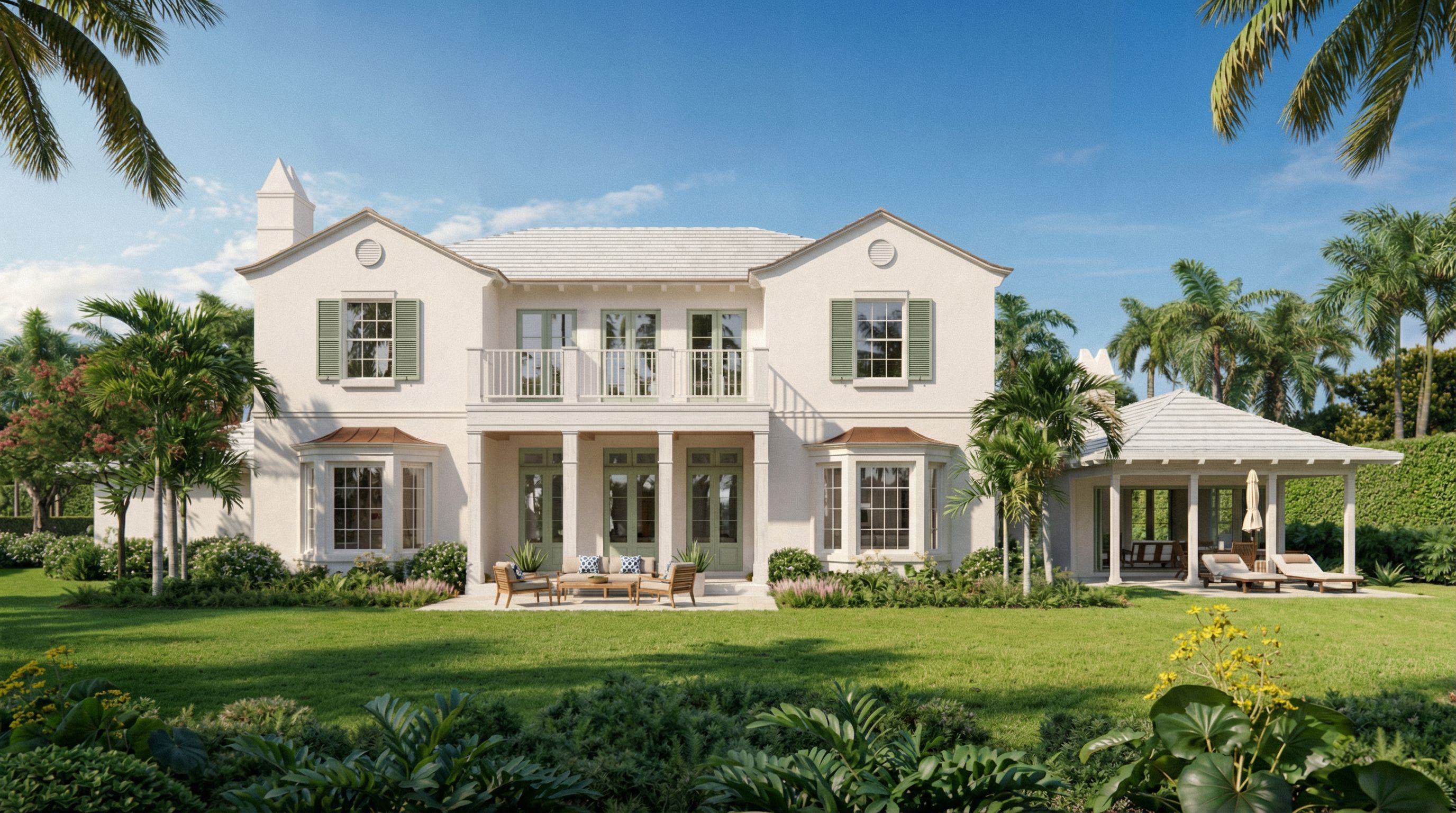
Ultra-photorealistic architectural exterior rendering generated directly from the provided rear elevation drawing and matching the massing shown in the reference image. The provided rear elevation must be treated as the exact architectural blueprint. The rendering must strictly preserve the geometry, proportions, rooflines, window sizes, spacing, balcony position, bay projections, and façade layout exactly as shown in the elevation. Do not reinterpret, redesign, or alter the architecture. The main house massing is a symmetrical two-story composition. It consists of a central recessed portion with a centered second-floor balcony and a covered terrace below, flanked by two slightly projecting two-story wings. Each wing is capped by a front-facing gable. The central portion of the house is set slightly back between the two projecting wings. Beneath the balcony is a covered ground-floor terrace supported by four columns. On both sides of this terrace are symmetrical projecting bay window volumes at the ground floor. These bays project forward from the wall plane and each is capped with a small muted copper roof. The overall composition is balanced, symmetrical, and horizontally ordered. The rear second-floor balcony is open to the sky and is not covered by a roof structure. There is only a shallow roof overhang extending approximately 2 feet over the doors behind the balcony. Do not add a covered balcony roof. A detached single-story cabana sits behind and to the side of the main house, approximately 20 feet back from the most forward rear face of the main house. The cabana should clearly read as further back in depth, while remaining proportional to the main house. The cabana has a simple hipped roof and a covered loggia facing the main house. The cabana loggia has four equally spaced columns across the opening. Behind the columns is a large multi-slide glass panel door system that opens the wall fully. Show the multi-slide glass wall open so the cabana reads as an indoor-outdoor pavilion. Do not change the size or proportions of the cabana opening. All rear-facing exterior doors are painted Benjamin Moore Fresh Dew, a soft pale mint green. Door placement and spacing must remain exactly as shown in the elevation. Materials: Exterior walls are smooth white stucco with subtle plaster texture and refined shadow lines. Window surrounds, headers, and sills are white stucco matching the walls, not stone and not contrasting trim. Columns, balcony railings, rafters, and exposed wood elements are whitewashed pecky cypress with a smooth matte finish and very subtle grain that is barely visible. Main roof is white concrete tile with realistic tile depth and a soft matte finish. Bay window roofs are natural copper with soft realistic patina tones, muted and complementary, not shiny or reflective. Chimneys are stucco and match the main wall finish. Do not add gutters or downspouts. Lighting: Natural mid-afternoon daylight around 3 PM. Lighting should feel realistic, balanced, and photographic, not overly bright or overexposed. Both visible faces of the architecture should be well lit. Use soft daylight with gentle natural shadows and subtle ambient bounce light so the rear façade and the secondary visible side are both clearly illuminated. White stucco should retain visible texture and shadow variation and should not appear blown out. Exposure and realism: Natural photographic exposure with balanced contrast. Softened highlights, realistic shadows, and subtle tonal variation. Avoid excessive brightness, excessive saturation, and overly perfect CGI lighting. The image should feel like professional architectural photography rather than a stylized render. Environment: Palm Beach coastal landscape setting. Manicured lawn, palms, layered tropical planting, and restrained ornamental grasses. Light shell stone or limestone terrace and patio surfaces. Bright blue sky with soft natural clouds. Camera and composition: Cinematic architectural money-shot perspective of the rear elevation. Three-quarter perspective that shows the massing clearly while preserving the elevation geometry. Camera slightly offset from center at eye level. 35mm architectural lens with realistic depth and minimal distortion. Composition should clearly show the symmetrical main house in the foreground and the cabana set back behind it. Critical constraints: Preserve the exact geometry of the provided rear elevation. Do not change roof shapes. Do not change balcony proportions. Do not change the bay window shapes or placement. Do not change window or door locations. Do not move the cabana too close to the main house. Do not redesign the architecture. Treat the elevation drawing as the strict blueprint and the reference image only as a guide for massing and spatial depth., keep exact camera angle
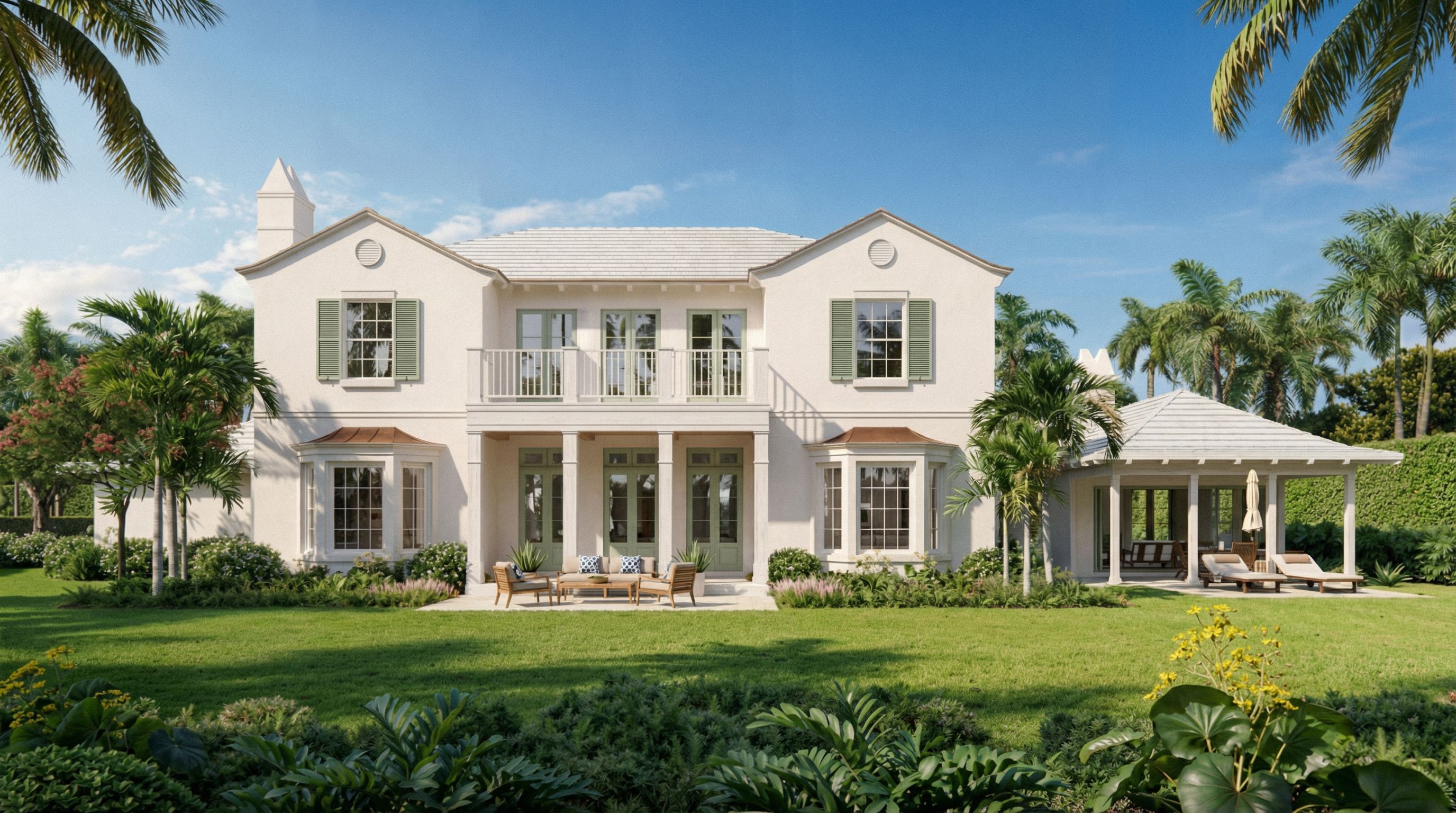
PromptUltra-photorealistic architectural exterior rendering generated directly from the provided rear elevation drawing and matching the massing shown in the reference image. The provided rear elevation must be treated as the exact architectural blueprint. The rendering must strictly preserve the geometry, proportions, rooflines, window sizes, spacing, balcony position, bay projections, and façade layout exactly as shown in the elevation. Do not reinterpret, redesign, or alter the architecture. The main house massing is a symmetrical two-story composition. It consists of a central recessed portion with a centered second-floor balcony and a covered terrace below, flanked by two slightly projecting two-story wings. Each wing is capped by a front-facing gable. The central portion of the house is set slightly back between the two projecting wings. Beneath the balcony is a covered ground-floor terrace supported by four columns. On both sides of this terrace are symmetrical projecting bay window volumes at the ground floor. These bays project forward from the wall plane and each is capped with a small muted copper roof. The overall composition is balanced, symmetrical, and horizontally ordered. The rear second-floor balcony is open to the sky and is not covered by a roof structure. There is only a shallow roof overhang extending approximately 2 feet over the doors behind the balcony. Do not add a covered balcony roof. A detached single-story cabana sits behind and to the side of the main house, approximately 20 feet back from the most forward rear face of the main house. The cabana should clearly read as further back in depth, while remaining proportional to the main house. The cabana has a simple hipped roof and a covered loggia facing the main house. The cabana loggia has four equally spaced columns across the opening. Behind the columns is a large multi-slide glass panel door system that opens the wall fully. Show the multi-slide glass wall open so the cabana reads as an indoor-outdoor pavilion. Do not change the size or proportions of the cabana opening. All rear-facing exterior doors are painted Benjamin Moore Fresh Dew, a soft pale mint green. Door placement and spacing must remain exactly as shown in the elevation. Materials: Exterior walls are smooth white stucco with subtle plaster texture and refined shadow lines. Window surrounds, headers, and sills are white stucco matching the walls, not stone and not contrasting trim. Columns, balcony railings, rafters, and exposed wood elements are whitewashed pecky cypress with a smooth matte finish and very subtle grain that is barely visible. Main roof is white concrete tile with realistic tile depth and a soft matte finish. Bay window roofs are natural copper with soft realistic patina tones, muted and complementary, not shiny or reflective. Chimneys are stucco and match the main wall finish. Do not add gutters or downspouts. Lighting: Natural mid-afternoon daylight around 3 PM. Lighting should feel realistic, balanced, and photographic, not overly bright or overexposed. Both visible faces of the architecture should be well lit. Use soft daylight with gentle natural shadows and subtle ambient bounce light so the rear façade and the secondary visible side are both clearly illuminated. White stucco should retain visible texture and shadow variation and should not appear blown out. Exposure and realism: Natural photographic exposure with balanced contrast. Softened highlights, realistic shadows, and subtle tonal variation. Avoid excessive brightness, excessive saturation, and overly perfect CGI lighting. The image should feel like professional architectural photography rather than a stylized render. Environment: Palm Beach coastal landscape setting. Manicured lawn, palms, layered tropical planting, and restrained ornamental grasses. Light shell stone or limestone terrace and patio surfaces. Bright blue sky with soft natural clouds. Camera and composition: Cinematic architectural money-shot perspective of the rear elevation. Three-quarter perspective that shows the massing clearly while preserving the elevation geometry. Camera slightly offset from center at eye level. 35mm architectural lens with realistic depth and minimal distortion. Composition should clearly show the symmetrical main house in the foreground and the cabana set back behind it. Critical constraints: Preserve the exact geometry of the provided rear elevation. Do not change roof shapes. Do not change balcony proportions. Do not change the bay window shapes or placement. Do not change window or door locations. Do not move the cabana too close to the main house. Do not redesign the architecture. Treat the elevation drawing as the strict blueprint and the reference image only as a guide for massing and spatial depth., keep exact camera angle
Date09 March 2026
Share