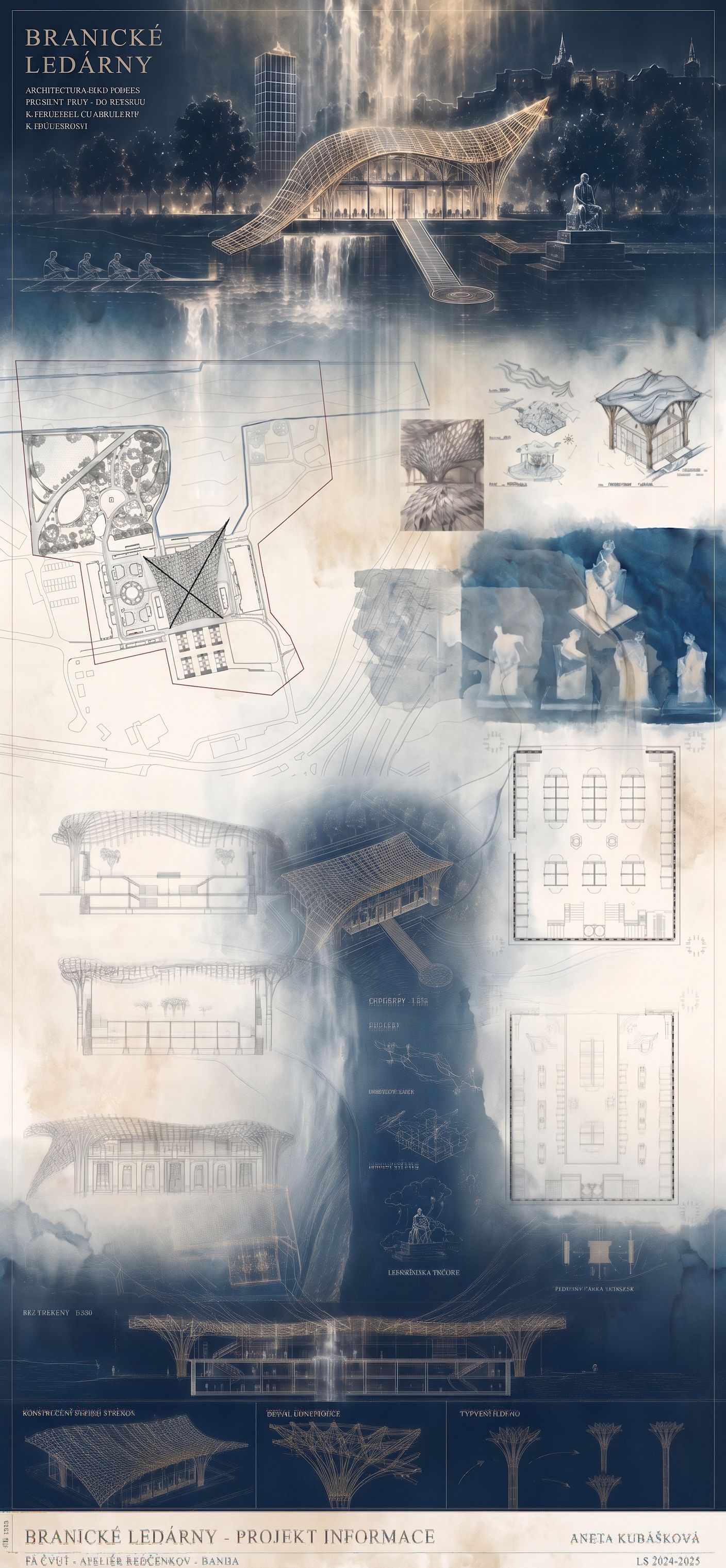
Rework this architectural presentation board WITHOUT changing the architecture, drawings, scales, proportions, dimensions, perspectives, or technical accuracy of any uploaded content. Preserve all plans, sections, elevations, diagrams, axonometries, and visualizations exactly as they are. Do not redraw the building differently. The goal is NOT to redesign the project but to transform the board composition into a more unified, cinematic, emotionally immersive architectural artifact. The current board feels too separated into individual blocks. Instead, create stronger visual continuity and flow between all drawings so the entire board feels like one connected atmospheric landscape rather than isolated images stacked vertically. Introduce a fluid compositional language inspired by: flowing water, melting ice, cyanotype wash effects, fog, ink bleeding into paper, layered tracing paper, erosion, vertical waterfalls, reflected light on water, architectural collages from high-end competition boards. Use transitions between drawings instead of hard separations. Let plans dissolve into textures, sections emerge from fog, diagrams float within water stains, and linework continue subtly across neighboring elements. The board should feel alive and interconnected. The top hero visualization should visually “bleed” downward into the board through mist, reflections, vertical water streams, cyanotype washes, and atmospheric overlays. The flowing roof geometry should subtly guide the eye throughout the entire composition. Make the middle section much more integrated: connect the site plan to the diagrams using line continuations and material textures, allow conceptual diagrams to overlap softly into the sculpture studies, integrate the sculpture sequence more poetically as a transformation narrative instead of isolated images, merge some drawings through translucent layers and shared textures, create subtle relationships between plans, sections, and roof geometry. Do NOT keep all drawings in rigid rectangular zones. Break the grid carefully and elegantly while preserving readability. Some drawings can partially overlap, fade, dissolve, or emerge from textured backgrounds. Use layering depth like architectural editorial design or gallery posters. The lower section should feel more grounded and tectonic: connect the large section with the structural roof diagrams, let the structural logic visually continue into the detail studies, use flowing lines from the roof lattice to unify the bottom composition. Reduce the feeling of empty beige paper areas. Replace them with subtle gradients, washed textures, atmospheric shadows, translucent overlays, faint construction lines, ghosted sketches, reflected water textures, or blurred fragments of drawings. Introduce more hierarchy and rhythm: some elements should dominate, some should quietly fade into the background, some should feel discovered only upon closer inspection. Keep the typography elegant and minimal, but integrate it into the atmosphere rather than placing it mechanically. Text can float subtly within fog or alongside diagrammatic lines. Use a refined palette: deep desaturated cyanotype blue, warm foggy beige, soft grey, muted gold highlights, wet concrete tones, pale watercolor whites. Avoid oversaturated blue or overly clean digital rendering. The final board should feel tactile, artistic, atmospheric, slightly mysterious, and emotionally powerful while still remaining architecturally precise and highly readable. The final result should resemble a premium international competition board, architectural exhibition poster, or conceptual editorial spread — sophisticated, edgy, poetic, and deeply connected to the themes of water, ice, erosion, transformation, and river landscape., keep exact camera angle
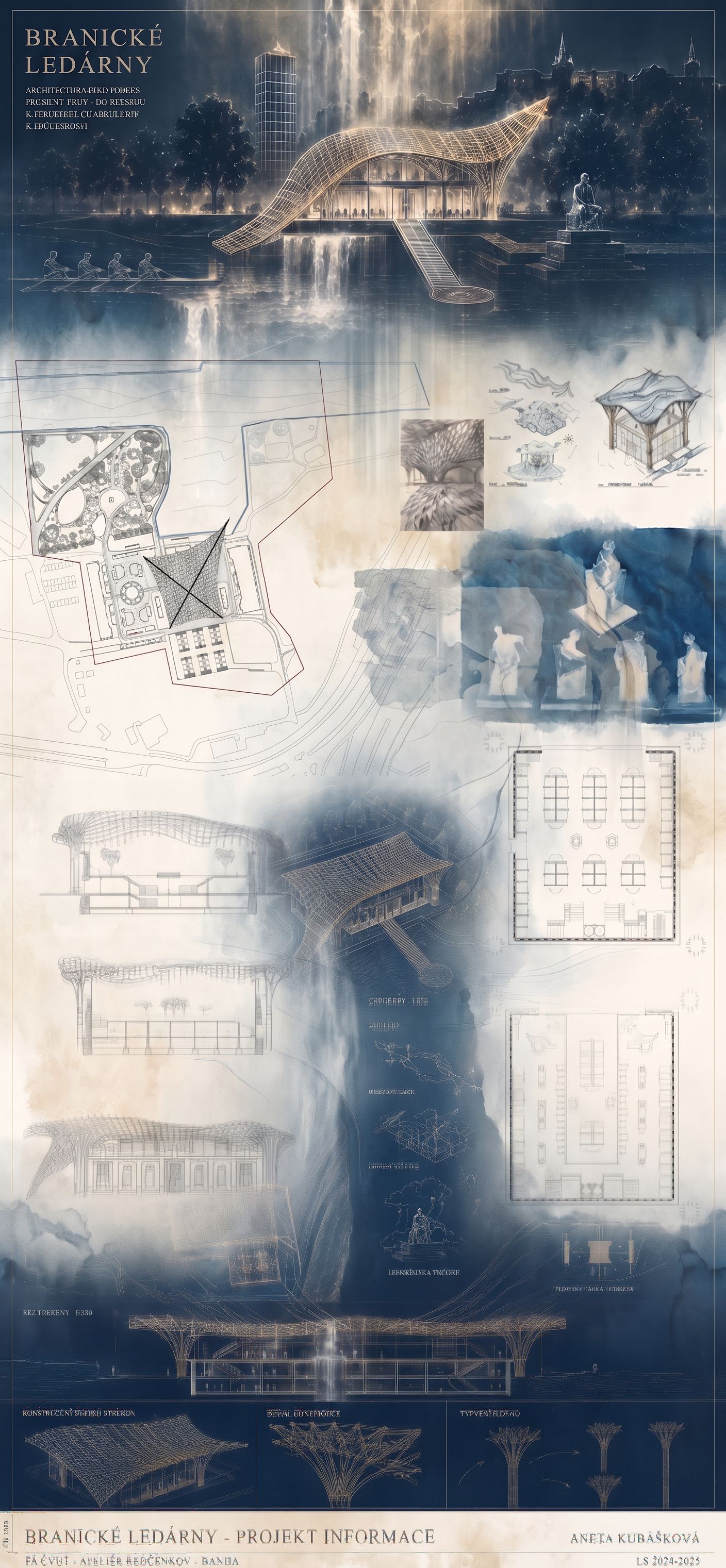
PromptRework this architectural presentation board WITHOUT changing the architecture, drawings, scales, proportions, dimensions, perspectives, or technical accuracy of any uploaded content. Preserve all plans, sections, elevations, diagrams, axonometries, and visualizations exactly as they are. Do not redraw the building differently. The goal is NOT to redesign the project but to transform the board composition into a more unified, cinematic, emotionally immersive architectural artifact. The current board feels too separated into individual blocks. Instead, create stronger visual continuity and flow between all drawings so the entire board feels like one connected atmospheric landscape rather than isolated images stacked vertically. Introduce a fluid compositional language inspired by: flowing water, melting ice, cyanotype wash effects, fog, ink bleeding into paper, layered tracing paper, erosion, vertical waterfalls, reflected light on water, architectural collages from high-end competition boards. Use transitions between drawings instead of hard separations. Let plans dissolve into textures, sections emerge from fog, diagrams float within water stains, and linework continue subtly across neighboring elements. The board should feel alive and interconnected. The top hero visualization should visually “bleed” downward into the board through mist, reflections, vertical water streams, cyanotype washes, and atmospheric overlays. The flowing roof geometry should subtly guide the eye throughout the entire composition. Make the middle section much more integrated: connect the site plan to the diagrams using line continuations and material textures, allow conceptual diagrams to overlap softly into the sculpture studies, integrate the sculpture sequence more poetically as a transformation narrative instead of isolated images, merge some drawings through translucent layers and shared textures, create subtle relationships between plans, sections, and roof geometry. Do NOT keep all drawings in rigid rectangular zones. Break the grid carefully and elegantly while preserving readability. Some drawings can partially overlap, fade, dissolve, or emerge from textured backgrounds. Use layering depth like architectural editorial design or gallery posters. The lower section should feel more grounded and tectonic: connect the large section with the structural roof diagrams, let the structural logic visually continue into the detail studies, use flowing lines from the roof lattice to unify the bottom composition. Reduce the feeling of empty beige paper areas. Replace them with subtle gradients, washed textures, atmospheric shadows, translucent overlays, faint construction lines, ghosted sketches, reflected water textures, or blurred fragments of drawings. Introduce more hierarchy and rhythm: some elements should dominate, some should quietly fade into the background, some should feel discovered only upon closer inspection. Keep the typography elegant and minimal, but integrate it into the atmosphere rather than placing it mechanically. Text can float subtly within fog or alongside diagrammatic lines. Use a refined palette: deep desaturated cyanotype blue, warm foggy beige, soft grey, muted gold highlights, wet concrete tones, pale watercolor whites. Avoid oversaturated blue or overly clean digital rendering. The final board should feel tactile, artistic, atmospheric, slightly mysterious, and emotionally powerful while still remaining architecturally precise and highly readable. The final result should resemble a premium international competition board, architectural exhibition poster, or conceptual editorial spread — sophisticated, edgy, poetic, and deeply connected to the themes of water, ice, erosion, transformation, and river landscape., keep exact camera angle
Date11 May 2026
Share