
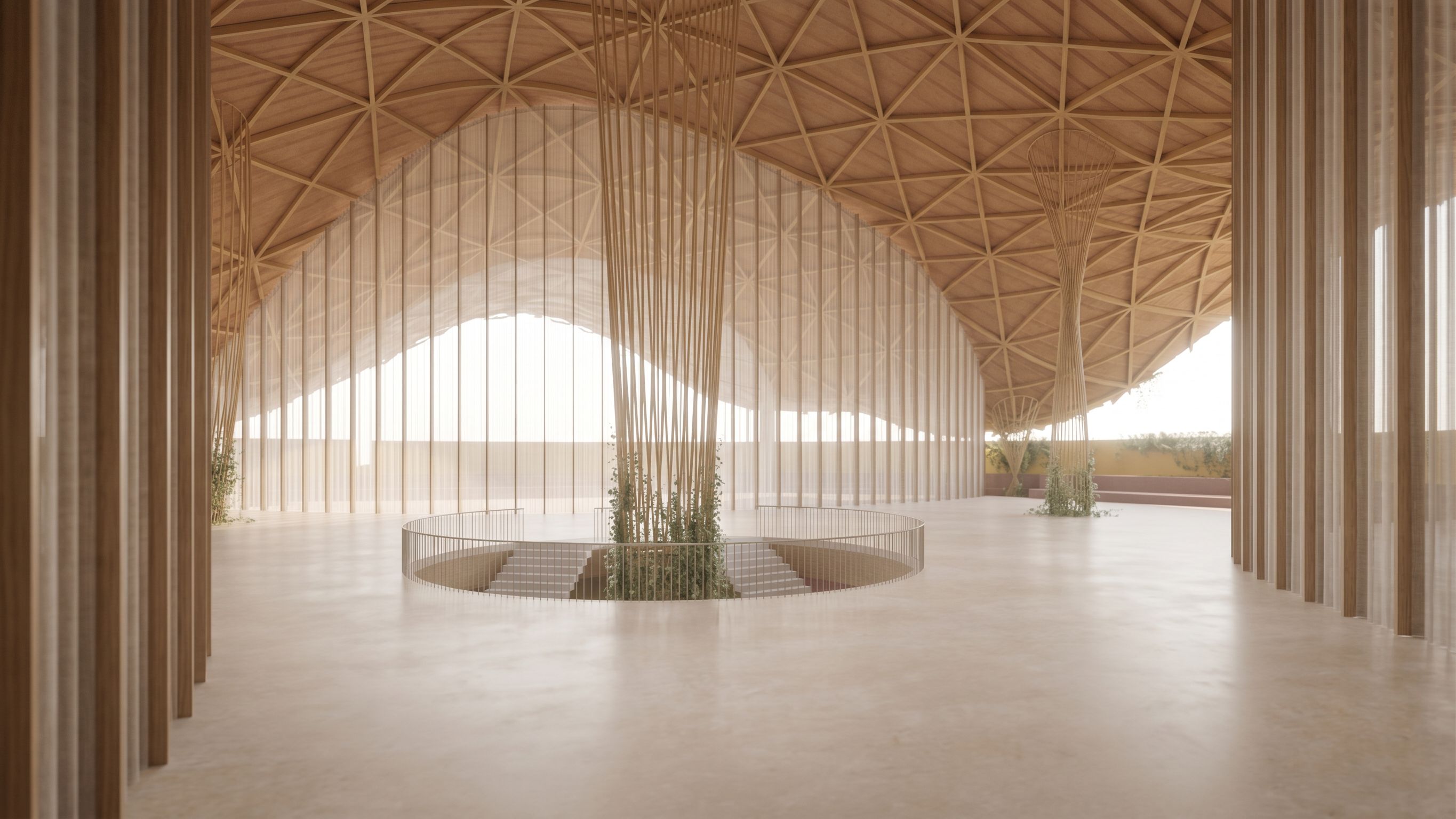
Transform this raw Rhino interior into a soft, dreamy, blurred atmospheric architectural render while strictly preserving the exact geometry, composition, proportions, camera angle, roof form, column placement, curtain locations, atrium opening, and all architectural elements exactly as modeled. Do not redesign, simplify, add furniture, or alter the structure. This is a material, light, atmosphere, and subtle planting translation only. Create a quiet, hazy, poetic interior with the following qualities: very soft diffused daylight gentle bloom around bright areas slight cinematic blur / shallow haze low-contrast tonal range warm beige, oat, sand, linen, pale wood, muted honey, and soft olive tones subtle atmospheric depth minimal, calm, meditative feeling high-end architectural visualization dreamlike but still believable soft washed-out realism, not illustrative slightly gauzy lens softness delicate glow through fabric Material direction: keep all fabric curtains / veil layers as the dominant visual element fabric should read as sheer woven linen or translucent mesh, vertically hanging, light beige to warm taupe fabrics should catch light softly and appear slightly layered, airy, and semi-transparent maintain the rhythm and density of every curtain line from the model wood framing / posts should become warm natural timber, matte finish, light to medium honey-brown floor should read as soft limewash concrete or pale stone, matte and lightly reflective roof / ceiling should feel warm and subdued, with natural material richness but not sharp texture structural elements should remain elegant and understated, never shiny any metal should be muted and soft, not glossy overall palette should feel natural, tactile, calm, and slightly sun-faded Greenery direction: add light, selective greenery only where architecturally appropriate greenery should feel integrated into the building, not decorated after the fact use soft climbing vines, trailing plants, and delicate planted moments place greenery near openings, edges, courtyard conditions, perimeter thresholds, columns, or places where light and air naturally reach allow some plants to cascade gently from upper edges or soften corners keep plant density restrained and intentional plants should never block the architecture or overpower the fabric greenery should feel like a quiet extension of the atmosphere use muted natural greens, slightly dusty and sun-softened avoid tropical, glossy, highly saturated, or oversized plants avoid heavy planters unless they are subtle and built-in no random indoor jungle effect Lighting direction: use indirect morning or late afternoon daylight light should filter through the sheer fabric layers avoid harsh sun patches and avoid dramatic contrast exterior should be bright and slightly overexposed so the interior feels softly backlit introduce a subtle glow through openings shadows should be very soft and barely defined interior should feel luminous, dusty, and quiet Atmosphere / image quality: add a soft-focus photographic quality very slight blur as if shot through a delicate gauze filter subtle filmic grain muted highlights soft blooming edges calm editorial architectural mood preserve detail, but let it dissolve gently in the brightest zones no crisp hyperreal sharpness no heavy contrast no saturated colors no dramatic sunset tones Important preservation instructions: do not change the design do not move or delete curtains, walls, columns, roof members, stair openings, railings, or screens do not add new architectural elements do not reinterpret the architecture do not change the spacing or thickness of elements do not alter the camera framing keep the render faithful to the original model, only upgrading materials, light, softness, atmosphere, and restrained integrated greenery Target aesthetic keywords: soft architectural haze, sheer linen veil, blurred realism, meditative daylight, warm neutral palette, tactile natural materials, soft integrated greenery, quiet luxury, diffused glow, atmospheric interior, ethereal but grounded, understated editorial render Negative prompt: sharp hyperreal detail, glossy surfaces, high saturation, dramatic shadows, strong contrast, redesign, added furniture, people, decorative objects, random potted plants everywhere, tropical jungle, oversized leaves, bright green saturation, colorful flowers, futuristic materials, polished metal, plastic textures, over-stylized illustration, cartoon effect, excessive fog, symmetrical distortion, changed geometry, changed roof, changed curtain layout Final look: Make the image feel like a softly blurred architectural photograph where light, fabric, natural materiality, and restrained greenery are more important than sharp detail. You can also use this extra greenery line at the very end if the software responds well to prompt stacking: Extra line: Introduce sparse, elegant greenery similar to soft courtyard vines and lightly cascading plants, placed only where daylight, thresholds, and structure naturally support them., keep exact camera angle
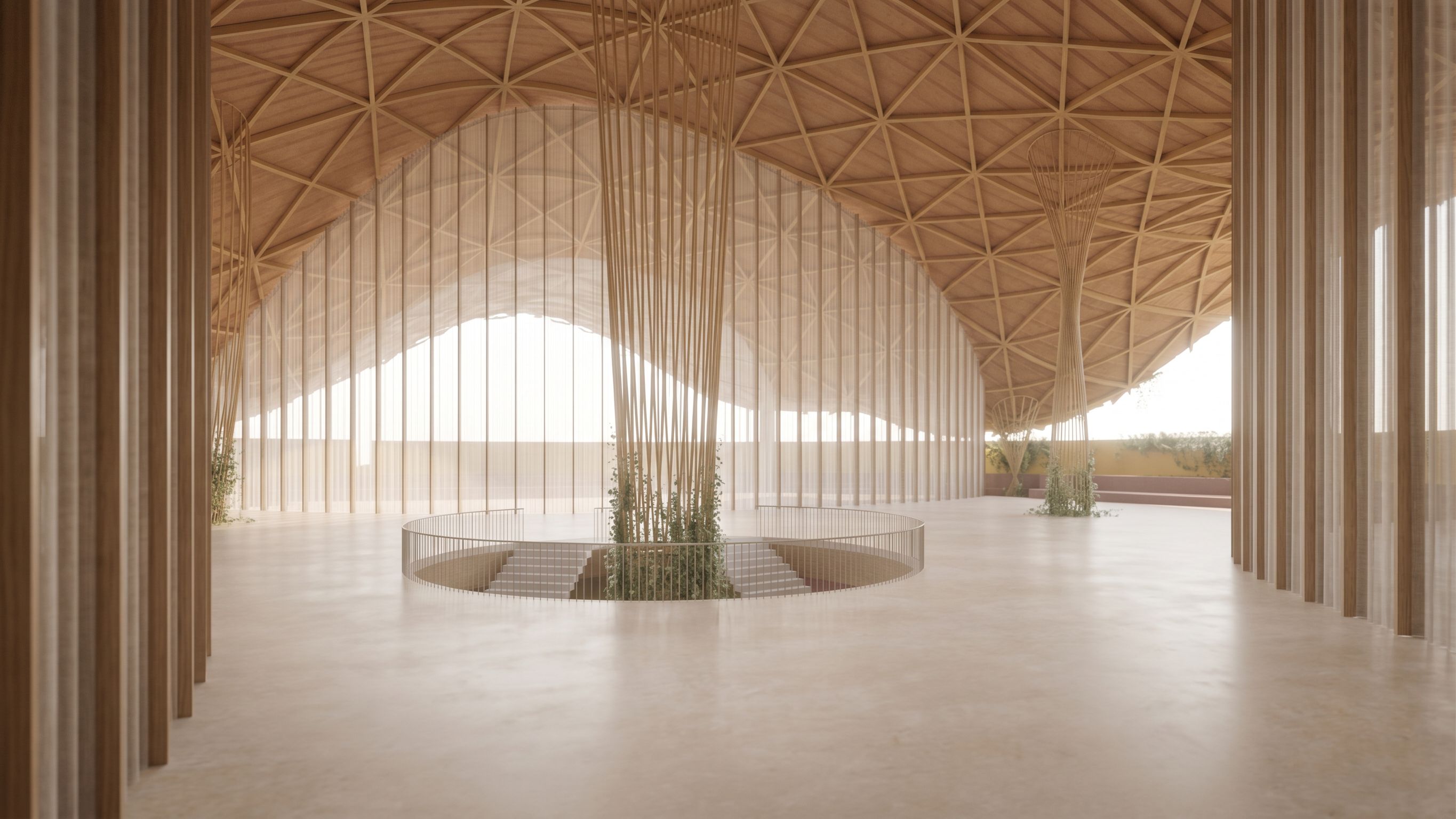
PromptTransform this raw Rhino interior into a soft, dreamy, blurred atmospheric architectural render while strictly preserving the exact geometry, composition, proportions, camera angle, roof form, column placement, curtain locations, atrium opening, and all architectural elements exactly as modeled. Do not redesign, simplify, add furniture, or alter the structure. This is a material, light, atmosphere, and subtle planting translation only. Create a quiet, hazy, poetic interior with the following qualities: very soft diffused daylight gentle bloom around bright areas slight cinematic blur / shallow haze low-contrast tonal range warm beige, oat, sand, linen, pale wood, muted honey, and soft olive tones subtle atmospheric depth minimal, calm, meditative feeling high-end architectural visualization dreamlike but still believable soft washed-out realism, not illustrative slightly gauzy lens softness delicate glow through fabric Material direction: keep all fabric curtains / veil layers as the dominant visual element fabric should read as sheer woven linen or translucent mesh, vertically hanging, light beige to warm taupe fabrics should catch light softly and appear slightly layered, airy, and semi-transparent maintain the rhythm and density of every curtain line from the model wood framing / posts should become warm natural timber, matte finish, light to medium honey-brown floor should read as soft limewash concrete or pale stone, matte and lightly reflective roof / ceiling should feel warm and subdued, with natural material richness but not sharp texture structural elements should remain elegant and understated, never shiny any metal should be muted and soft, not glossy overall palette should feel natural, tactile, calm, and slightly sun-faded Greenery direction: add light, selective greenery only where architecturally appropriate greenery should feel integrated into the building, not decorated after the fact use soft climbing vines, trailing plants, and delicate planted moments place greenery near openings, edges, courtyard conditions, perimeter thresholds, columns, or places where light and air naturally reach allow some plants to cascade gently from upper edges or soften corners keep plant density restrained and intentional plants should never block the architecture or overpower the fabric greenery should feel like a quiet extension of the atmosphere use muted natural greens, slightly dusty and sun-softened avoid tropical, glossy, highly saturated, or oversized plants avoid heavy planters unless they are subtle and built-in no random indoor jungle effect Lighting direction: use indirect morning or late afternoon daylight light should filter through the sheer fabric layers avoid harsh sun patches and avoid dramatic contrast exterior should be bright and slightly overexposed so the interior feels softly backlit introduce a subtle glow through openings shadows should be very soft and barely defined interior should feel luminous, dusty, and quiet Atmosphere / image quality: add a soft-focus photographic quality very slight blur as if shot through a delicate gauze filter subtle filmic grain muted highlights soft blooming edges calm editorial architectural mood preserve detail, but let it dissolve gently in the brightest zones no crisp hyperreal sharpness no heavy contrast no saturated colors no dramatic sunset tones Important preservation instructions: do not change the design do not move or delete curtains, walls, columns, roof members, stair openings, railings, or screens do not add new architectural elements do not reinterpret the architecture do not change the spacing or thickness of elements do not alter the camera framing keep the render faithful to the original model, only upgrading materials, light, softness, atmosphere, and restrained integrated greenery Target aesthetic keywords: soft architectural haze, sheer linen veil, blurred realism, meditative daylight, warm neutral palette, tactile natural materials, soft integrated greenery, quiet luxury, diffused glow, atmospheric interior, ethereal but grounded, understated editorial render Negative prompt: sharp hyperreal detail, glossy surfaces, high saturation, dramatic shadows, strong contrast, redesign, added furniture, people, decorative objects, random potted plants everywhere, tropical jungle, oversized leaves, bright green saturation, colorful flowers, futuristic materials, polished metal, plastic textures, over-stylized illustration, cartoon effect, excessive fog, symmetrical distortion, changed geometry, changed roof, changed curtain layout Final look: Make the image feel like a softly blurred architectural photograph where light, fabric, natural materiality, and restrained greenery are more important than sharp detail. You can also use this extra greenery line at the very end if the software responds well to prompt stacking: Extra line: Introduce sparse, elegant greenery similar to soft courtyard vines and lightly cascading plants, placed only where daylight, thresholds, and structure naturally support them., keep exact camera angle
Date21 April 2026
Share