- Prompt
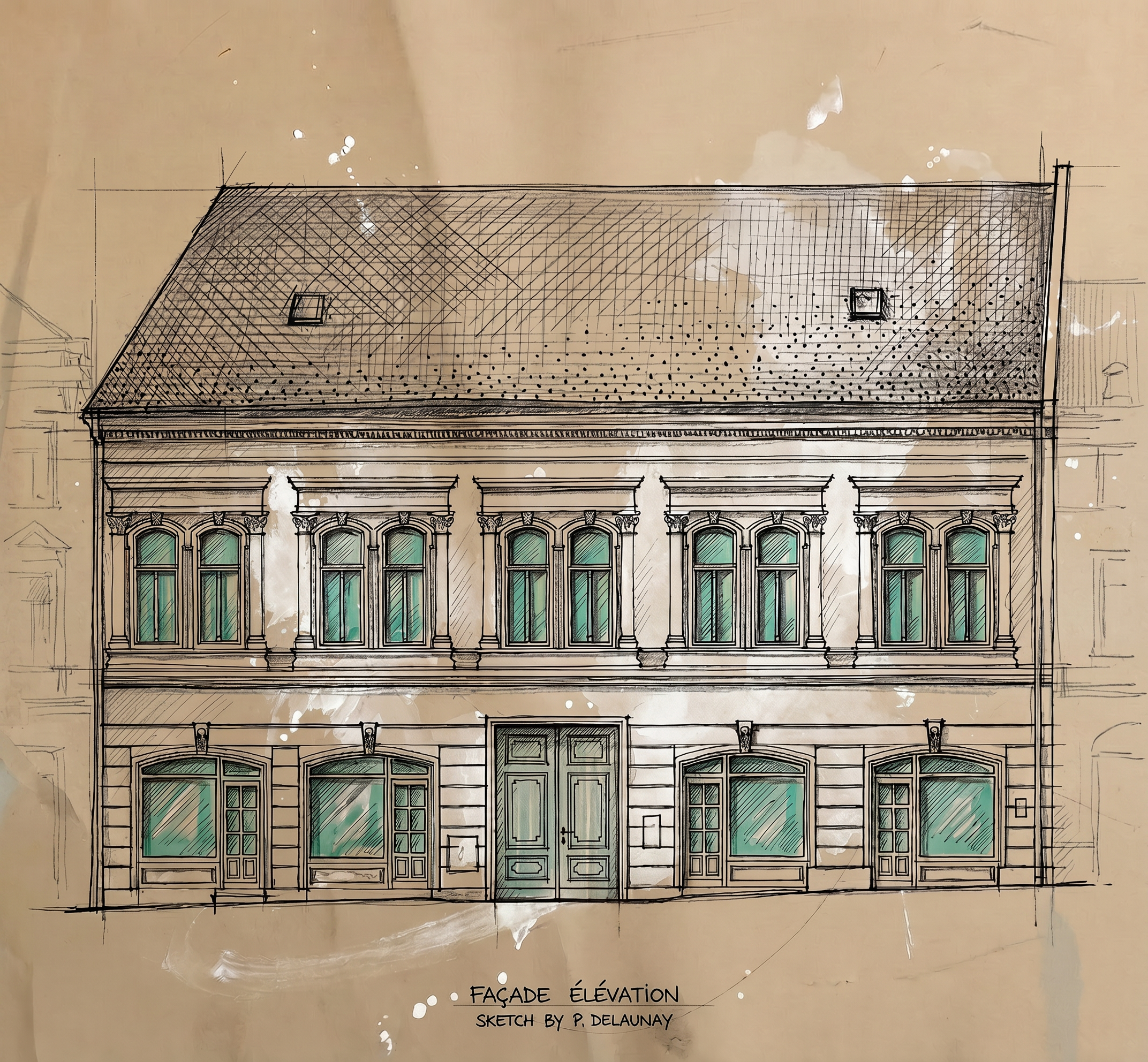
- Use the uploaded image as the primary reference and preserve the main building exactly. The central building must remain the dominant subject and retain its original proportions, perspective, geometry, structure, and architectural character. Do not redesign or alter the main building. Transform the presentation into an expressive, highly artistic architectural sketch created by a professional architect. The drawing should feel handmade, emotional, and atmospheric rather than technical or photorealistic. Use loose freehand linework, confident sketch strokes, visible construction lines, layered pencil marks, ink pen accents, expressive hatching, soft marker washes, tonal variations, and subtle imperfections typical of an architect's sketchbook. Create depth and atmosphere through varying line weights: strong, dark lines for the main building and lighter, more abstract lines for secondary elements. Introduce neighboring buildings only as contextual background architecture. These surrounding buildings should be represented as faint outlines, loose silhouettes, incomplete sketches, and suggestive forms. They must remain understated and partially dissolved into the background, serving only to establish urban context and scale. Avoid detailed rendering of the neighboring structures. Use minimal linework, light hatching, and atmospheric fading so that attention remains entirely on the main building. The composition should resemble a high-end competition sketch, an architect's conceptual presentation drawing, or a gallery-quality architectural illustration. Emphasize artistic expression, depth, atmosphere, and hand-crafted character. The sketch should feel like it was drawn directly by an experienced architect during the design process, with elegance, confidence, and creative freedom. Subtle paper texture, sketchbook aesthetic, unfinished edges, layered tracing-paper effect, architectural storytelling, poetic atmosphere, museum-quality architectural sketch. The main building remains sharp and visually dominant. All surrounding context must stay soft, abstract, incomplete, and secondary. No photorealism. No CAD appearance. No technical drawing aesthetic.
- Created
- June 18, 2026
- Seed
- 0