- Prompt
- Absolutely. For an AI render enhancer, the key is to **explicitly lock the geometry, structure, materials, camera angle, and proportions**, while allowing improvements only to lighting, color balance, realism, and image quality.
**4K ARCHITECTURAL RENDER ENHANCEMENT PROMPT**
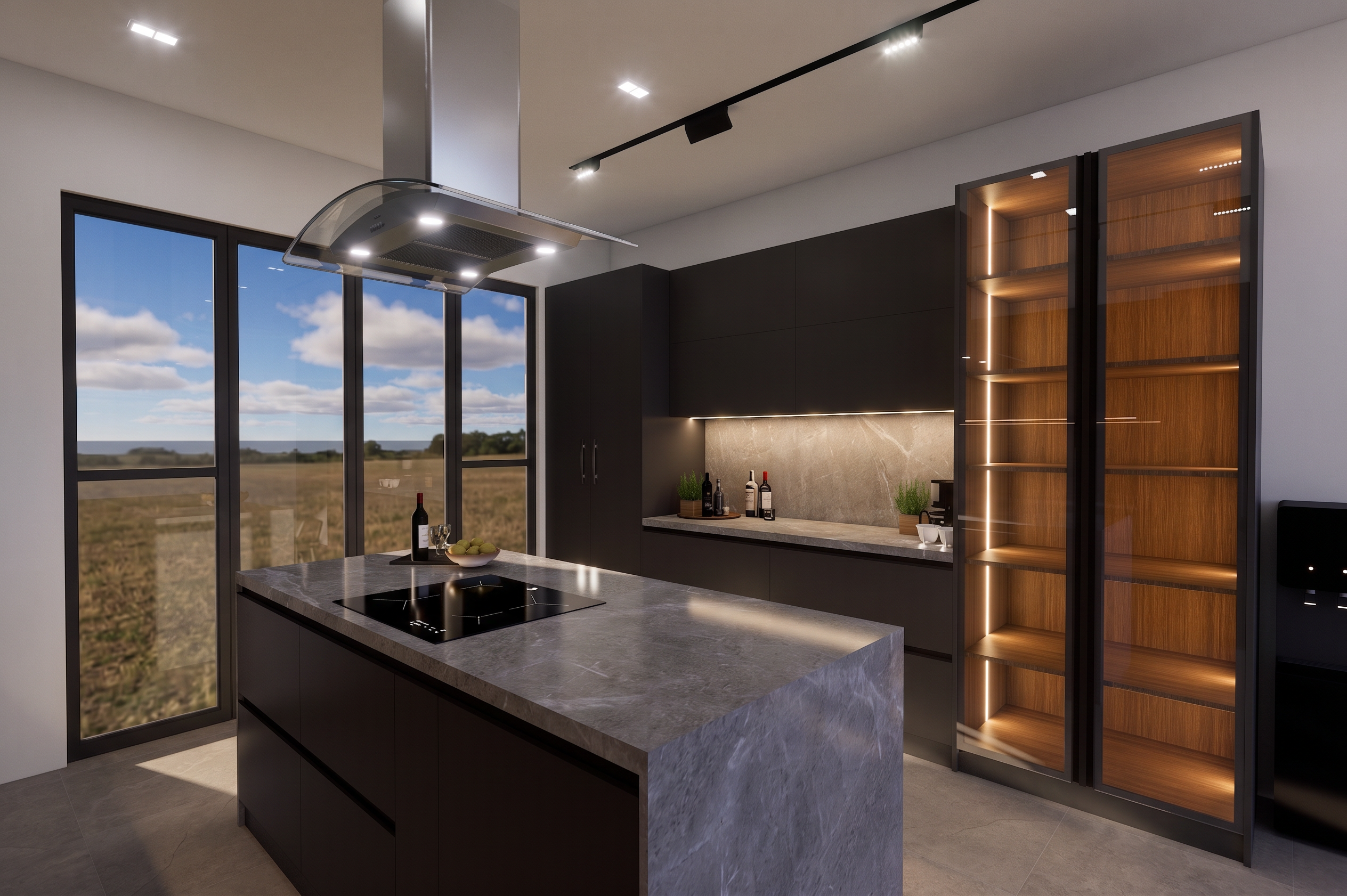
Enhance the provided architectural render into a **high-end, photorealistic 4K architectural visualization**.
**IMPORTANT: PRESERVE THE EXISTING DESIGN EXACTLY.** Do not redesign, remodel, reconstruct, or modify any architectural element.
### PRESERVE EXACTLY
* Keep the **existing building structure and geometry** unchanged.
* Keep the **exact proportions, dimensions, scale, and layout**.
* Keep the **same roof form, walls, columns, beams, doors, windows, openings, stairs, railings, and other architectural elements**.
* Keep the **exact camera position, viewing angle, perspective, and composition**.
* Keep the **existing materials exactly as shown**. Do not replace, redesign, or introduce different materials.
* Preserve the existing **textures, patterns, finishes, colors, and material appearance** as much as possible.
* Do not add or remove architectural features.
* Do not change the number, size, or location of windows, doors, columns, walls, or other elements.
* Do not change the building's architectural style or design intent.
### ONLY IMPROVE VISUAL QUALITY
Improve the rendering quality while maintaining the original design:
* Upgrade to **ultra-realistic 4K quality**.
* Improve **global illumination and realistic light distribution**.
* Add natural and physically accurate **daylight and soft shadows**.
* Improve ambient occlusion and contact shadows.
* Improve reflections and realistic light interaction with existing materials.
* Enhance realistic **color balance, exposure, contrast, and white balance**.
* Improve material definition and texture sharpness **without changing the materials**.
* Increase depth, realism, and visual clarity.
* Add subtle realistic environmental lighting.
* Reduce noise, pixelation, jagged edges, and rendering artifacts.
* Improve image sharpness and fine architectural details.
* Maintain realistic proportions and perspective.
* Use professional architectural photography quality.
### LIGHTING
Use **natural, realistic architectural lighting** appropriate to the existing scene. Improve the direction, softness, intensity, and color temperature of the light without changing the architecture.
Create realistic shadows with proper contact between objects and surfaces. Avoid excessive HDR effects, unrealistic glow, overexposure, or dramatic lighting that changes the original appearance.
### FINAL RESULT
The final image should look like a **professional 4K architectural visualization produced with a high-end rendering engine**, while appearing as though the original project was rendered at a much higher quality.
**DO NOT ALTER THE ARCHITECTURE. DO NOT CHANGE THE MATERIALS. DO NOT CHANGE THE CAMERA ANGLE. DO NOT ADD OR REMOVE ELEMENTS. ONLY ENHANCE LIGHTING, COLOR, REALISM, SHARPNESS, DETAIL, AND OVERALL RENDER QUALITY.**
**Priority:**
1. Preserve existing geometry and structure
2. Preserve existing materials and finishes
3. Preserve camera angle and composition
4. Improve lighting and realism
5. Improve color, shadows, reflections, and atmosphere
6. Produce a clean, highly detailed, photorealistic 4K result
- Created
- August 22, 2026