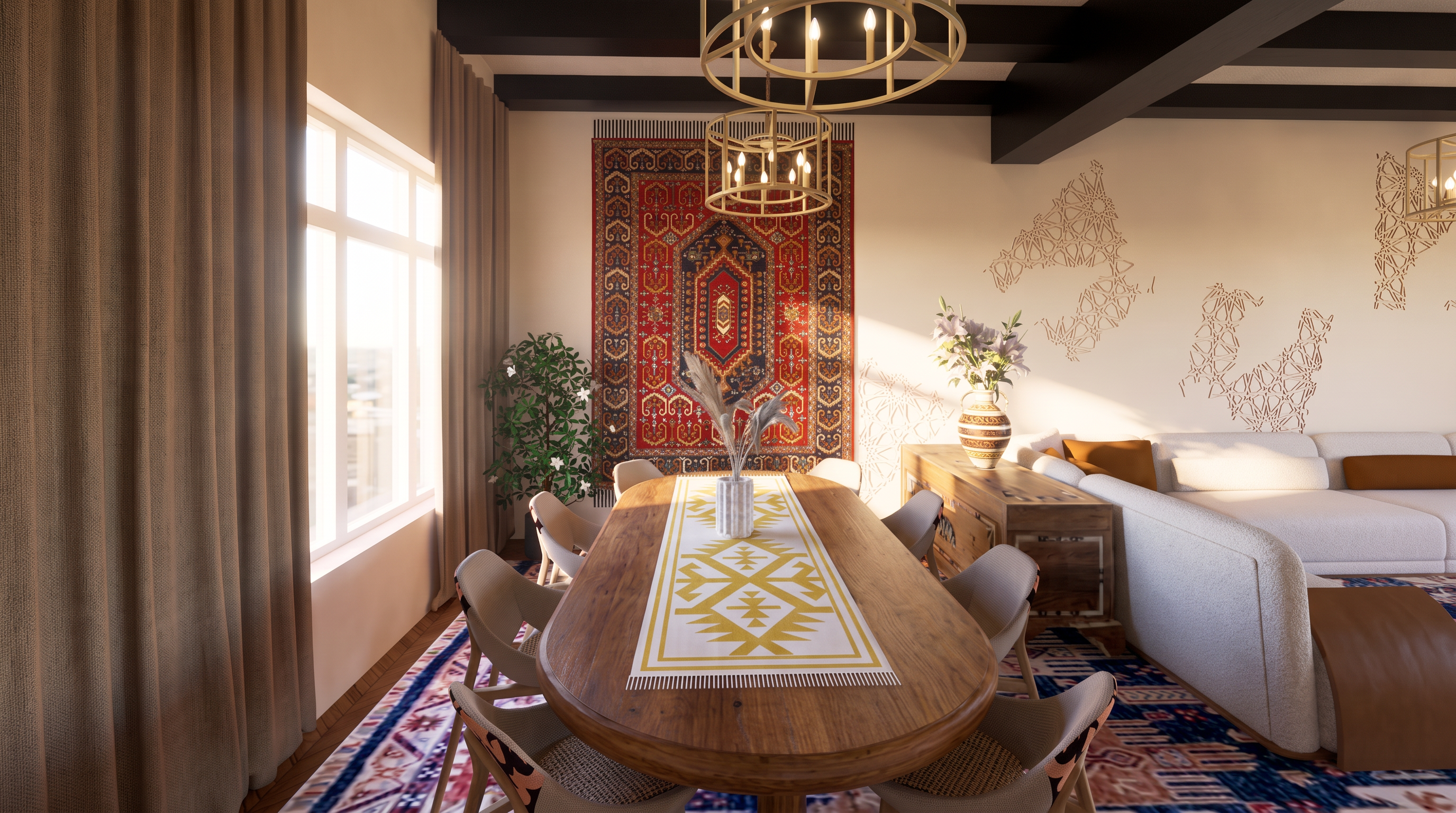
- Prompt
- MAXIMUM PHOTOREALISM REQUIREMENT:
The final image must achieve the highest possible level of photorealism and must be visually indistinguishable from a professional real interior photograph.
Every material must behave physically correctly under light:
- realistic roughness
- realistic specular response
- realistic reflection intensity
- accurate light absorption
- subtle micro-imperfections
- realistic edge highlights
- natural contact shadows
- physically correct ambient occlusion
Avoid perfectly sterile or overly clean CGI surfaces.
Introduce extremely subtle real-world imperfections:
- microscopic surface variation
- tiny unevenness in painted MDF
- natural wood grain variation
- slight differences in roughness
- realistic textile fiber direction
- subtle compression of carpet fibers
- natural shadow softness
- very slight material irregularity
TEXTILE REALISM:
The rug must show individual fine wool fibers, short pile depth, realistic woven structure, micro-shadows between fibers, slight irregularity in the surface, subtle direction changes in the pile and physically accurate light scattering through the textile fibers.
WOOD REALISM:
The wooden floor and wooden wall panel must have true-to-scale wood grain, natural pores, soft color variation, subtle knots, correct roughness, realistic reflections and no repeating procedural texture pattern.
METAL REALISM:
The gold/brass handles must look like real brushed metal with anisotropic reflections, fine brushed lines, subtle edge highlights, soft reflection falloff and realistic metallic roughness. Avoid fake mirror-like gold.
PAINTED SURFACE REALISM:
Wardrobe doors and walls must have realistic matte painted surfaces with ultra-fine microtexture, subtle light diffusion and slight natural imperfections visible only at close distance.
LIGHTING REALISM:
Lighting must behave physically correctly.
Use realistic global illumination, indirect light bounce, natural penumbra, realistic shadow density and physically accurate falloff.
The sunlight must interact naturally with every material:
- soft warm reflection on the wooden floor
- subtle diffuse light on matte wardrobe fronts
- controlled highlights on brass handles
- micro-shadows inside carpet fibers
- natural bounce light from nearby walls and floor
The concealed technical LED lighting must produce realistic wall washing, soft indirect glow, correct brightness falloff and no artificial neon effect.
CAMERA REALISM:
Simulate a professional full-frame interior photography camera.
Use realistic focal length, natural depth, correct exposure, realistic dynamic range and accurate white balance.
No fisheye distortion.
No exaggerated depth of field.
No artificial sharpening.
No excessive HDR effect.
RENDER QUALITY:
Professional 3ds Max + Corona Renderer / V-Ray level.
Path-traced global illumination.
Physically based rendering.
High sample quality.
Clean anti-aliasing.
Accurate ray-traced reflections.
Accurate refractions where applicable.
Soft realistic shadow transitions.
High dynamic range.
Natural tone mapping.
Subtle photographic bloom only where physically justified.
The result must NOT look AI-generated, illustrative, overprocessed or overly perfect.
It should look like a real room photographed by a professional architectural photographer after completion of the interior.
ULTRA REALISTIC.
PHOTOREALISTIC.
ARCHVIZ STUDIO QUALITY.
REAL MATERIAL SCALE.
REALISTIC MICROTEXTURES.
PHYSICALLY ACCURATE LIGHTING.
NATURAL IMPERFECTIONS.
REAL CAMERA EXPOSURE.
REALISTIC SHADOWS.
REALISTIC REFLECTIONS.
REALISTIC TEXTILE FIBERS.
REALISTIC WOOD GRAIN.
REALISTIC BRUSHED METAL.
NO CGI LOOK.
NO AI LOOK.
- Created
- October 2, 2026