AI Rendering vs Traditional Rendering
AI Render Studio Team · May 28, 2026
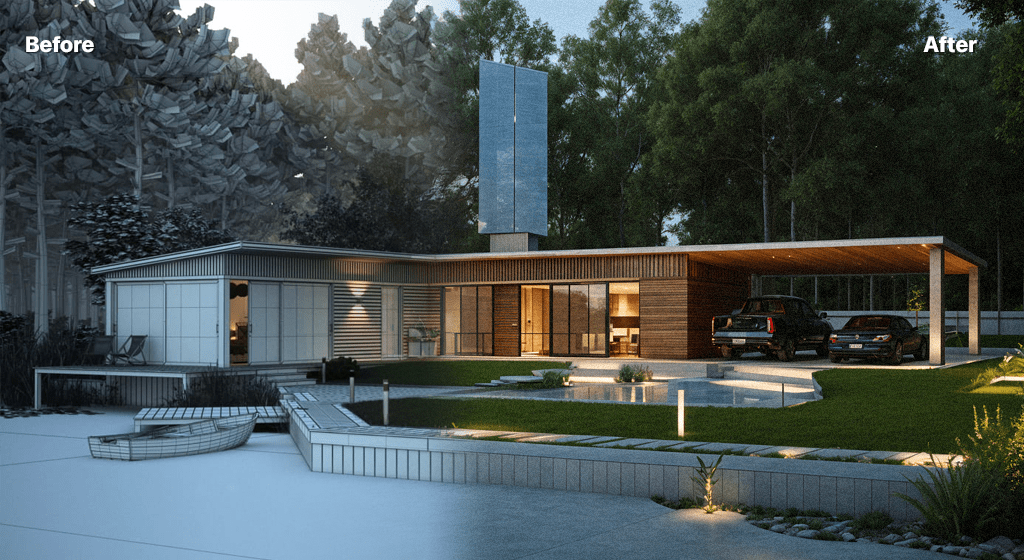
AI rendering and traditional rendering both produce photoreal images of a design, but they get there in completely different ways — and they are good at different things. Traditional renderers such as V-Ray, Corona and Lumion simulate light physically, bouncing rays through a fully set-up 3D scene. AI rendering uses models trained on millions of images to infer realistic materials, lighting and context directly from an input. The practical difference shows up in speed, control and where each fits in a project.
Speed
This is the starkest gap. A traditional render of a detailed scene can take minutes to hours per frame, plus the upfront work of assigning materials, placing lights and tuning settings. AI rendering returns a photoreal image in seconds from a single model export, photo or sketch. When you need ten options for a client meeting tomorrow, AI is in a different league.
Accuracy and control
Traditional rendering wins on precision. Because it simulates real physics in a scene you control, you get exact materials, accurate shadows, and repeatable, art-directable output — essential for final marketing hero shots and anything contractual. AI rendering trades some of that fine control for speed: you guide it with style choices and prompts rather than tuning every light, so output varies between generations. For concept and presentation work that variance is fine; for measured, repeatable imagery, traditional tools still lead.
Cost and hardware
Traditional rendering often needs a powerful GPU or a render farm and paid licenses. AI rendering runs in the cloud and works from a browser on any device, usually on a credit or subscription model. For small teams without rendering hardware, AI removes a real barrier. We break down the numbers in our guide to architectural rendering cost.
Which to use, and when
It is not either/or — most teams use both. Reach for AI rendering early and in the middle of a project: concept exploration, feasibility, competition boards, option studies and client presentations, where communicating an idea fast matters most. Reach for traditional rendering at the end, for the final, pixel-perfect, fully art-directed images. A common workflow is to explore dozens of directions with AI, lock the design, then produce the final hero shot traditionally.
Try the AI side of the workflow
AI Render Studio packages AI rendering into architecture-tuned tools for exterior, interior and sketch-to-render work. Upload a model export, photo or sketch and get a photoreal result in seconds. For the full picture, see our guide to AI rendering for architecture and our comparison of AI rendering tools.
FAQ
Is AI rendering better than traditional rendering?
Neither is strictly better — they serve different stages. AI rendering is faster and ideal for concept and presentation work; traditional rendering is more precise and controllable for final marketing imagery. Most teams use both.
Can AI rendering replace V-Ray or Lumion?
For early concept work and rapid option studies, often yes. For final, art-directed, physically accurate hero shots, traditional engines like V-Ray and Lumion still lead. Many architects use AI upstream and traditional rendering for the last mile.
Does AI rendering need a powerful GPU?
No. AI Render Studio renders in the cloud and runs in any browser, so you do not need a dedicated GPU or render farm.
Keep reading
Try it yourself
Render your design in seconds.
Turn a sketch, model or photo into a photoreal render. Start free — 3 credits, no credit card.